

2026 California Labor Law Updates in Brief
New legislation is coming into force that will strengthen employee rights across all industries. Each of these bills has been signed and will become active on varying dates.
Here are the bills you need to know about. Detailed information about each piece of legislation is included in the sections that follow:
- SB642: Establishes pay scale transparency and removes sex-based wage discrimination.
- SB261: Strengthens collections of unpaid wage judgments.
- SB590: Paid Family Leave is expanded starting July 1, 2028.
- AB692: Bans many “stay-or-pay” agreements that restrain employment.
- AB250: Reopens a window (Jan 1, 2026 - Dec 31, 2027) to file certain sexual assault claims if an employer “cover-up” is alleged.
- SB809:Clarifies that vehicle ownership doesn’t make a worker an independent contractor and reaffirms the employer's duty to reimburse personal vehicle use.
- AB858: Extends right-to-rehire protections for hospitality workers through Jan 1, 2027; allows DLSE enforcement to continue for prior violations.
- SB464: Expands employer pay-data reporting.
- SB294: Requires an annual “Know Your Rights” notice to employees.
- SB513: Expands “personnel records” to include training details.
- SB648: Employers must maintain accurate records for all gratuities.
- AB774: Expands wage garnishment reporting.
Minimum Wages for California
California has a high cost of living, so its minimum wages far exceed the federal minimums. Therefore, the minimum wage varies by location and job type.
California’s 2026 minimum wages are:
- $16.90/hour standard minimum wage.
- The minimum wage for fast food workers is $20/hour.
- Healthcare workers receive a minimum wage of $19.28 - $25/hour, depending on the type of facility they work in.
California Minimum Wage for Tipped Workers
Tipped workers must receive at least the standard minimum wage, which the employer must pay without using tips as a credit. In other words, tips cannot be counted as wages.
- Tips remain the sole property of the worker who receives them.
- Employers are not allowed to take any percentage of tips.
- Tips are excluded when calculating overtime rates.
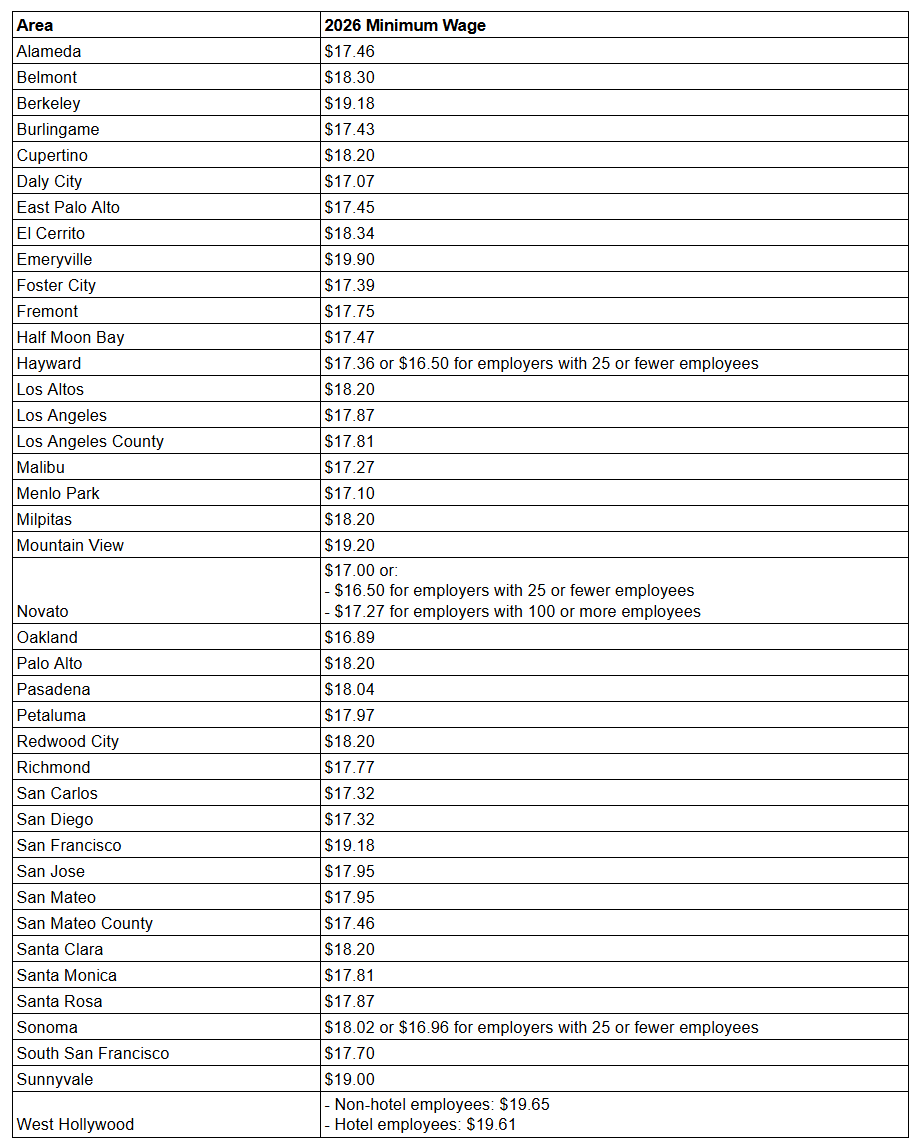
California County and City Minimum Wages
There are unique minimum wage thresholds for businesses located in the following areas:
California 2026 Minimum Wage Exemptions
Several professions are exempt from California’s minimum wage thresholds as long as they earn at least $70,304/year (twice the full-time minimum wage).
These are:
- Executive, administrative, and professional occupations
- Computer workers
- Salespersons
- Individuals who are the spouse, parent, or child of the employer
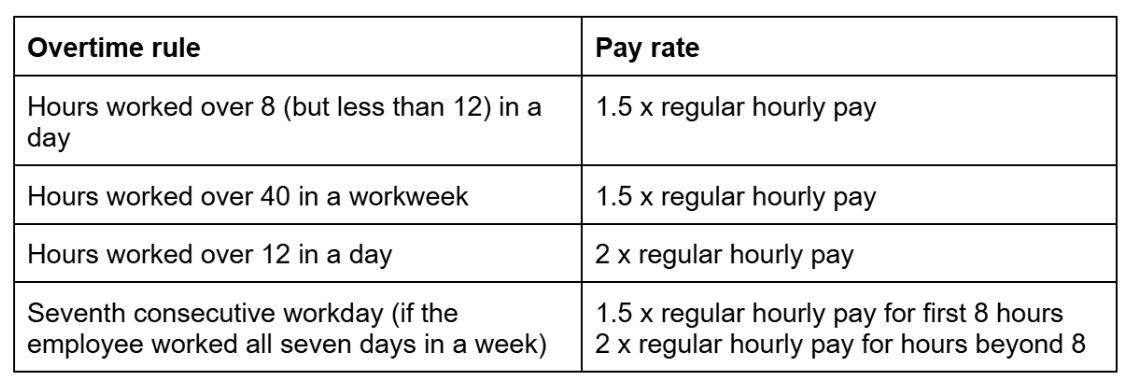
California 2026 Overtime Laws
California has specific rules on overtime that far exceed the FLSA rule of 1.5 x regular pay for hours worked over 40.
California 2026 Meal and Rest Break Laws
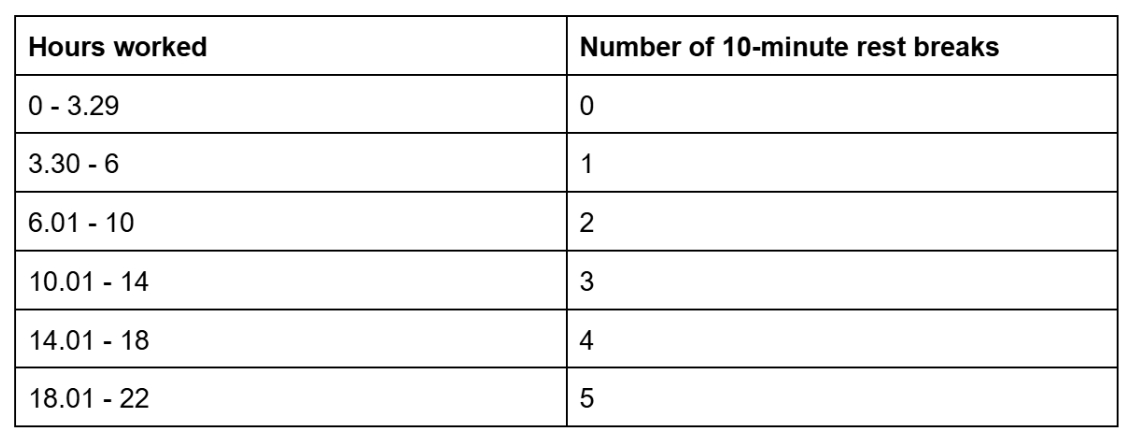
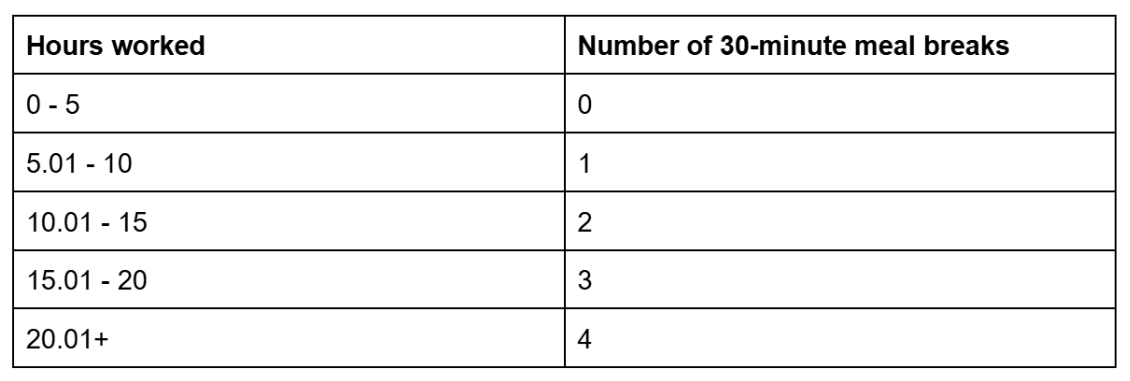
There are very clear rules on when rest and meal breaks must be provided. The number of breaks an employee receives depends directly on their total hours worked during a shift.
Mandatory rest breaks:
Mandatory meal breaks:
Additionally:
- Employees cannot be required to perform any work duties while taking a meal break.
- For 5+ hour shifts, the 30-minute meal break must start before the end of the 5th hour. Employees can waive it if their shift is 6 hours or less, or agree to a paid on-duty meal break.
- For 10+ hour shifts, the second 30-minute meal break must start before the end of the 10th hour. Employees can waive the second only if they work 12 hours or less and didn’t waive the first.
- While the employer is responsible for allowing breaks, it is solely the employee's responsibility to actually take them.
California 2026 Meal and Rest Break Exemptions
Some industries have modified meal and rest break rules, including:
- Healthcare: May waive one of two meal periods for long shifts if there is mutual consent.
- Motion pictures: Meal break trigger is after 6 hours instead of 5.
- Transportation: Interstate truck drivers are fully exempt from meal and rest break rules.
- Unionized workers: Can deviate from standard break rules if a collective bargaining agreement is made.
California 2026 Reporting Time Pay
If an employee reports to work as scheduled but ends up working less than half their scheduled shift/day, they are owed reporting time pay.
This equates to:
- Half their scheduled shift at their regular hourly rate.
- At least 2 hours and no more than 4 hours pay for the scheduled shift.
If the worker reports for a second shift in the same workday but is sent home after less than 2 hours, they must be paid for 2 hours at their regular hourly rate.
No reporting time pay is due in the following circumstances:
- If the employee leaves of their own accord (voluntary).
- If work is interrupted due to an “act of God” (earthquake, wildfire, power outage, etc.).
- If the employee operates on a paid standby status.
California 2026 Employee Pay Frequency and Accepted Pay Methods
Employers must pay their employees according to the following rules:
- Workers must be paid at least twice monthly or weekly.
- Wages must be paid on pre-designated days.
- Payment days must be within 7 days once a pay period has ended.
Employers can pay their workers using cash, check, or direct deposit. Employers must provide itemized wage statements (paystubs) per pay period that include:
- Hours worked
- Deductions
- Pay rate
- Overtime
- Gross and net pay
California 2026 Wage Garnishment Rules
In 2026, California will modernize its wage garnishment system by implementing the eGarnishment Program.
This allows the Franchise Tax Board to serve wage garnishment orders electronically.
Additionally, AB774 comes into force on July 1, 2026, which will require employers to document the personnel, date, and method involved in serving any withholding orders.
Californian employers can withhold wages in accordance with these rules:
- Employers must receive an official withholding form or a court order.
- A copy must be presented to the employee within 10 days of receipt.
- The Employer’s Return (WG-005) form must be completed and returned within 15 days.
- Deductions must begin 30 days after serving the order.
- The maximum garnishment amount is the lesser of 25% of disposable earnings or the amount by which disposable earnings exceed 40 times the state minimum wage.
California 2026 Final Pay Rules
Once an employee has left employment, the employer must act swiftly to issue their final paycheck:
- If an employee is laid off or fired: All wages are owed immediately, including accrued vacation and any other compensation owed.
- Employee resignation with at least 72 hours' notice: Final wages are due on the last day of their employment.
- Employee resignation with no notice: Final wages must be paid within 72 hours of departure.
If final wages are delayed or withheld, the employer is liable to pay waiting time penalties to a maximum of 30 days.
California Minimum Notice Period
California is an at-will state, so no notice of employment termination is required by the employer or employee.
The exception is mass layoffs or relocation, which requires employers to give at least 60 days' notice.
California 2026 Predictive Scheduling Rules
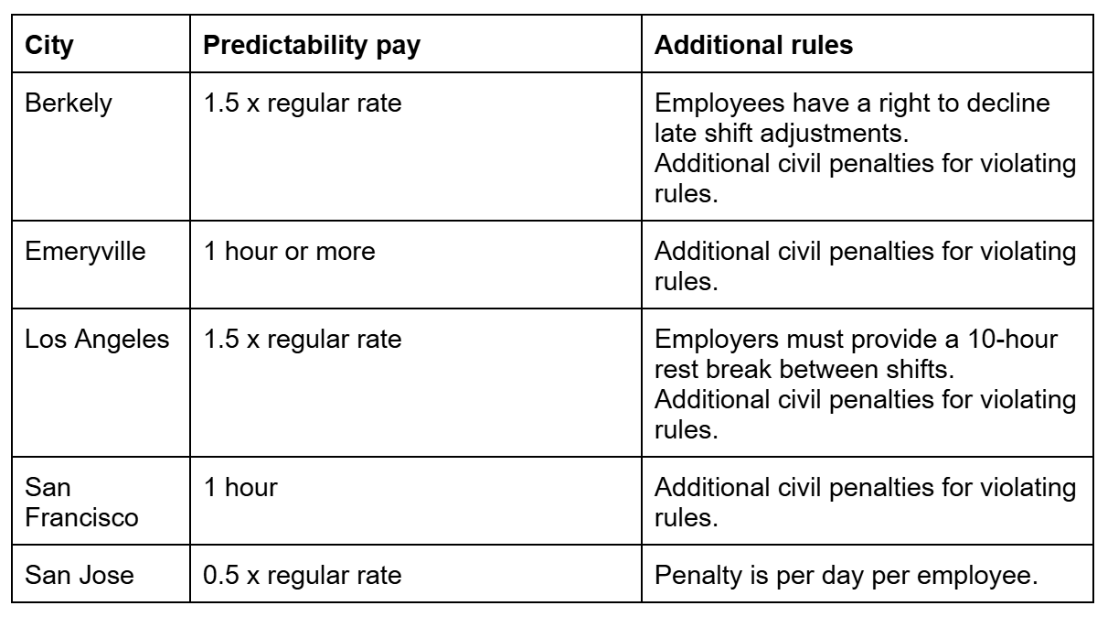
California does not have state-wide predictive scheduling laws. However, several cities have implemented their own rules primarily for retail, hospitality, and food service workers.
The rules determine additional compensation if an employer changes a schedule with less than 14 days' notice:
California 2026 Recordkeeping Rules
California’s recordkeeping rules have detailed stipulations on what records employers must retain and for how long:
- Employers are obligated to keep detailed payroll records, including:
- Daily and weekly hours worked per employee
- Overtime hours
- Wages paid
- Deductions
- Tip allocations
- Most records must be retained for at least 3 years.
- Tax records may have longer retention periods.
- Electronic recordkeeping isn’t mandated, but it’s strongly encouraged. Time tracking software is an acceptable method for maintaining records of hours worked.
- Employees have a right to view their personnel records.
Additionally, some new, expanded rules are coming into force:
- Senate Bill 513: Comes into force on January 1, 2026. It stipulates that employers must allow current and former employees to request, receive, and inspect copies of their personnel records related to training, education, grievances, and performance.
- Senate Bill 464: Private employers with 100+ employees must collect and maintain demographic data (race, ethnicity, sex, orientation, etc.) separately from other personnel records.
- Senate Bill 648: Starting in 2026, employers must maintain accurate records of all gratuities paid to tipped employees, including credit card tips. Strict remittance timelines apply.
California 2026 Time Off, Sick, and Family Leave Laws
A new expansion to job-protected leave is coming into force on January 1, 2026.
- Under AB406, employees (or family members of employees) who are victims of crime (including stalking, sexual assault, and domestic violence) can claim paid leave under the Healthy Workplaces, Healthy Families Act.
- Additionally, any employee serving on a trial or inquest jury is also entitled to this leave.
Paid Sick Leave
The Healthy Workplaces, Health Families Act enables employees to either:
- Accrue at least 1 hour of paid sick leave per 30 hours worked.
- Receive an upfront grant of at least 40 hours per year.
Sick leave can be used for:
- Personal illness
- Preventive care
- Care of a family member
- Victims of domestic violence, sexual harassment, crime, or stalking
- Jury duty
Unpaid Family and Medical Leave
The California Family Rights Act (CRFA) provides up to 12 weeks of job-protected, unpaid leave for:
- Birth, adoption, or fostering of a child
- Serious health conditions (employee or family member)
- Care of a designated person
To qualify, the employer must have 5+ employees, and the employee must have been employed for at least a year and have worked at least 1,250 hours in the past year.
The Family and Medical Leave Act (FMLA) provides similar leave as noted above (up to 12 weeks), but applies to employers with 50+ employees.
Both CFRA and FMLA tend to run concurrently if requirements are met.
Pregnancy Disability Leave provides up to 4 months of unpaid leave for employees with pregnancy-related disabilities. Employees must meet the same qualifying conditions as outlined for CRFA.
Paid Family Leave
Paid Family Leave provides a partial wage payment for up to 8 weeks in a 12-month period for:
- Bonding with a child (birth, adoption, or fostering)
- New family caregivers
- Employees taking time off to support a military family member
The partial wage depends on the employee’s salary and is a minimum of $50 to a maximum of $1,681 per week.
Paid family leave is not job-protected, but can run concurrently with other job-protected benefits like CRFA or FMLA.
Paid Vacation Leave
California law does not mandate employers to provide paid vacation time.
However, if employers choose to offer it, they must stick to the following rules:
- Vacation time is earned incrementally.
- It cannot be forfeited.
- “Use it or lose it” policies are illegal, but employers can place a cap on accrual until existing vacation leave is used.
- If an employee leaves employment, the employer must pay for all accrued, unused vacation time as part of their final paycheck.
- Employers must maintain clear written policies for paid vacation time.
Miscellaneous Leave
- Up to 2 hours of paid leave is permitted to let an employee vote.
- Job-protected paid leave is provided if the employee must perform emergency response duties.
- Employers with 25+ employees must offer unpaid leave for school activities and emergencies.
- Employers with 15+ employees must offer up to 30 days of paid and 30 days of unpaid leave to employees involved in organ donation.
- Employers with 5+ employees must provide at least 5 days of bereavement leave for:
- Death of a family member
- Miscarriage or stillbirth
- A failed adoption or assisted reproduction attempt
Key California Workplace Rights and Protections for 2026
Discrimination
Employers with 5+ employees are prohibited from discriminating against employees over protected characteristics, during employment, and throughout hiring stages.
Harrassment
All employers are prohibited from harassing a worker over protected characteristics.
Retaliation
Employers cannot retaliate against an employee who:
- Exercise their rights
- Reports violations
- Participates in investigations
“Know Your Rights” Notice
Employers must provide a written notice to all employees during the hiring stage that informs them of their rights.
- From February 1, 2026, this expands to all employees on an annual basis.
- Rights must include California and federal laws, wage laws, leave rights, and immigration-related protections.
SB614: Pay Equity Enforcement Act
From January 1, 2026:
- Employers must provide employees with transparent pay scales.
- Employers with 15+ employees must include pay scale information in job postings.
- Employers are prohibited from paying an individual less based on their sex.
- The time that an employee can claim for equal pay violations is extended to 3 years.
AB692: “Pay or Stay” Ban
From January 1, 2026:
- Many agreements that require workers to pay back training or recruiting costs if they leave are now banned.
Wage Claim Enforcement
The California Labor Commissioner now has expanded authority to enforce workplace protections and wage claims, including:
- Posting public notices of employers who receive unsatisfactory judgments.
- Increasing penalties for wage violations and theft.
AB288: Unionization
From January 1, 20206:
- The California Public Employment Relations Board (PERB) is now able to oversee and certify union elections and determine unfair labor practices.
- The law protects employees’ rights to organize and engage with collective bargaining agreements.
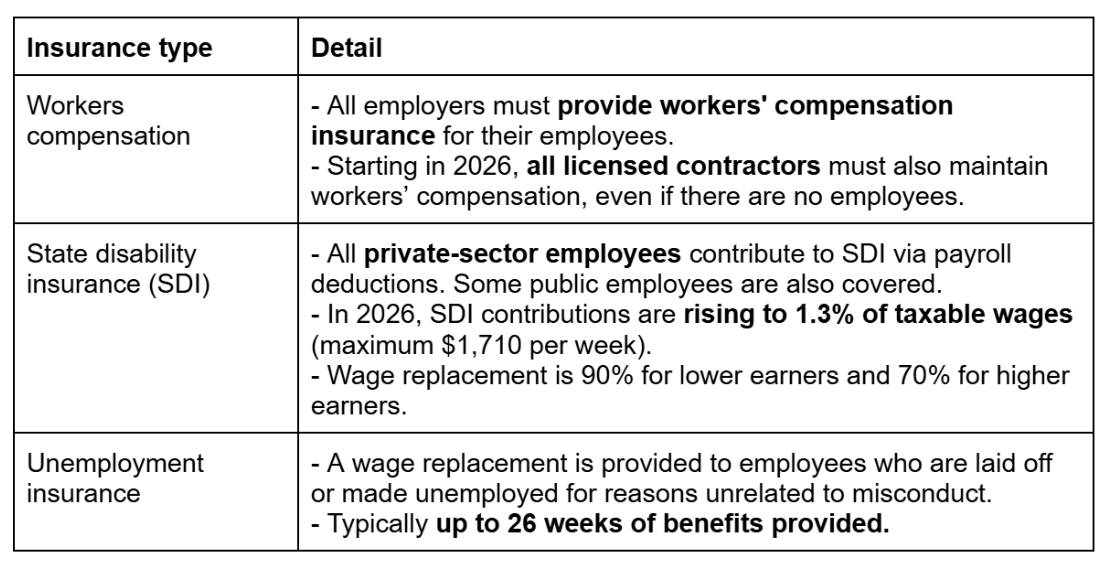
California 2026 Workers' Compensation and Insurance
California 2026 Child Labor Laws
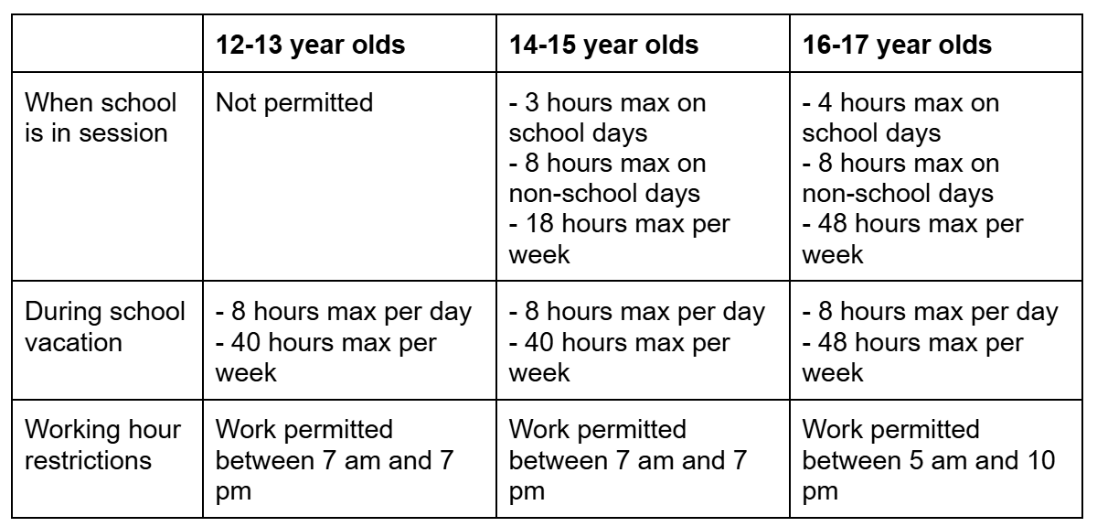
California places strict limits (according to age) on how many hours a child can work per day.
Additionally:
- All minors under 18 must hold a valid, school-issued work permit.
- Child workers are not allowed to be employed in a hazardous occupation, including mining, sawmilling, manufacturing, construction, meat processing, and more.
- Child workers under 14 are prohibited from most nonagricultural employment. Typical exemptions include newspaper delivery and acting.
- Exemptions from hour restrictions can apply to children working in the entertainment industry.
- Employers must disclose child labor and employment, regardless of capacity and activity.
Here’s a breakdown of permitted hours by age:
For more information on California’s labor laws and 2026 updates, consult the Department of Industrial Relations website.


