

Yet 74% of US employers use some form of online tracking tools to monitor work activities, including real-time screen monitoring (59%). Employers say it improves productivity, but the data suggest otherwise.
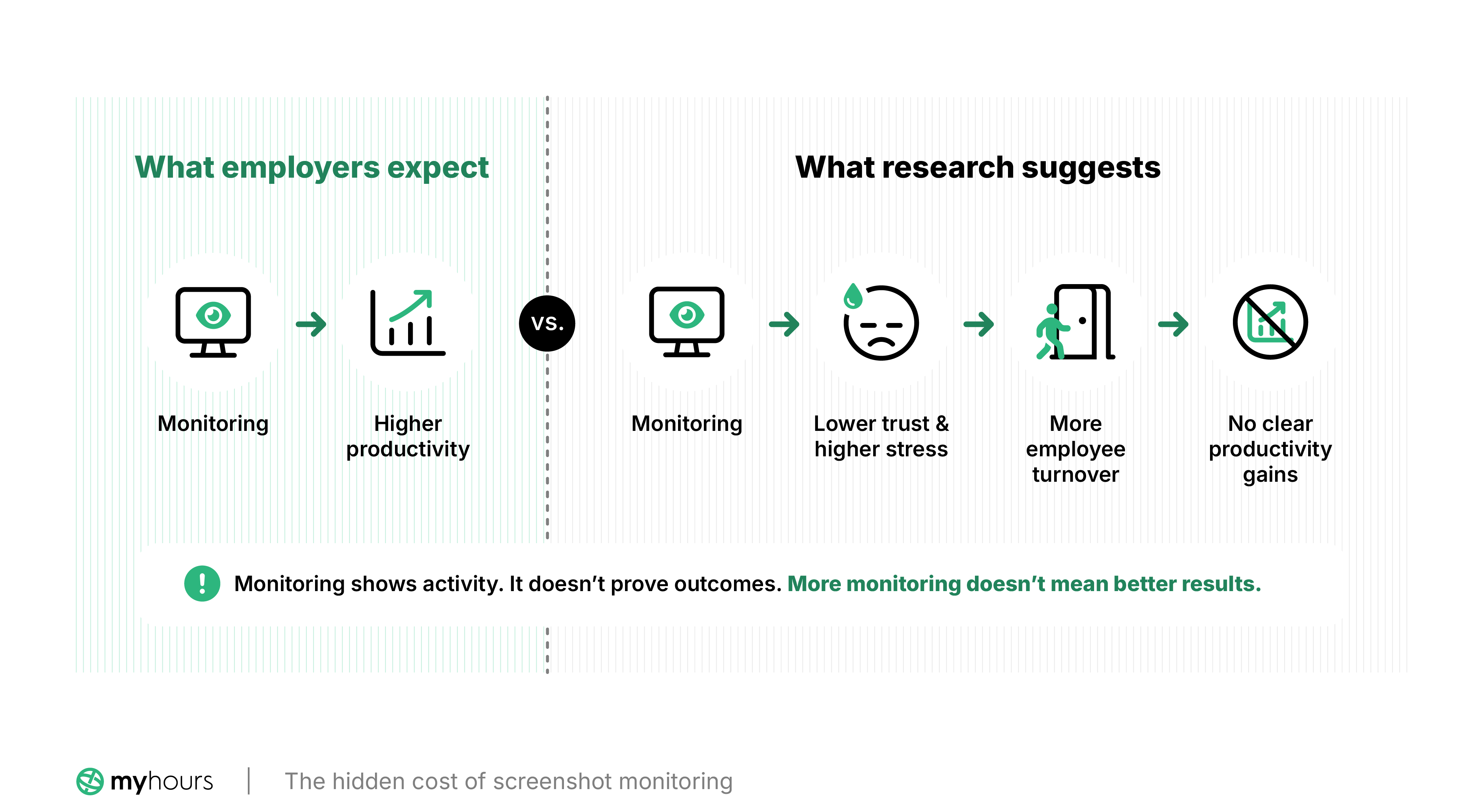
Screenshot surveillance can actually have a detrimental effect on businesses, with hidden costs ranging from data leaks to higher turnover. And even at its best, it can’t answer the questions that matter to an organization: Did the project stay within budget? Which clients are profitable?
Time tracking answers those questions without surveillance. This article breaks down what screenshot monitoring really costs and why accurate hours against a budget are a better solution.
What is Screenshot Monitoring?
Screenshot monitoring is a form of workforce surveillance where screenshots are taken of an employee's screen at regular intervals. It uses specific software that runs in the background and is typically deployed across an organization to measure productivity.
The idea is that screenshots provide visual proof of activity and what the employee has been working on throughout the day.
Why Do Employers Do It?
The main reason employers use screenshot monitoring is to understand how an employee spends their time. For example, the screenshots may reveal how idle time is spent or which applications are creating the most distractions.
They can also be used as proof of work and to verify that employees are actually working on their assigned tasks.
Some organizations may also use screenshot monitoring as a security measure to detect possible data leaks or insider risk.
Employers often favor screenshot monitoring over keystroke logging or mouse movement detection because it feels less invasive. It also gives a simple, at-a-glance record of activity, which can feel more concrete than other metrics.
Why Screenshot Monitoring is a Problem
While there are some benefits to using screenshot monitoring, it can pose significant risks to organizations.
The thing is, screenshots collect a huge amount of data, a lot of which should never be exposed.
For example, if a worker accesses sensitive data when a screenshot is taken, it now presents a data security risk or privacy violation. This can lead to compliance or legal issues.
Then there is the employee experience to consider. Workers don’t like to feel like they’re being constantly watched. It’s like having an invisible manager looking over your shoulder at all times, creating an environment that feels more like surveillance than trust, which isn’t pleasant for anyone.
Perhaps most interestingly, screenshot monitoring is not a good indicator of productivity.
According to Slack’s The State of Work in 2023 report, executives primarily measure productivity through visible activity, while workers want to be measured according to their KPIs and goals.
Additionally, employees spend 32% of their time on performative work that gives the impression of productivity, but isn’t actually productive.
Screenshots only tell part of the story. A day’s worth of screenshots might show that an employee answered their emails, used the sales platform, and worked on documents, but they say nothing about whether any meaningful progress was made towards their goals or if the worker provided any value.
In the end, companies may end up paying for invasive surveillance that damages trust without improving output.
"Screenshot monitoring shows what an employee was doing, but not whether the work was done well or created real business value. More monitoring doesn't lead to better results, it often leads to lower productivity, higher employee turnover, and increased costs for the business."
Is There a Better Alternative to Screenshot Monitoring?
No matter what form the employee surveillance takes, be it screenshots, keyboard logging, or mouse movement detection, the results are the same.
Vendors may market these tools as productivity boosters or theft prevention measures, but they frequently create new problems around privacy and trust.
In reality, most organizations don’t need to know every website or application a worker visits. The most important thing is whether or not work is progressing and if projects are on track.
This is where time tracking software offers a more balanced approach.
Rather than aggressive oversight, time tracking focuses on outcomes and activities.
Employees record time against projects and tasks, giving managers visibility into workloads and productivity, without collecting intrusive screenshots.
The result is greater transparency without the privacy concerns. You get to maintain trust and morale, which in turn raises productivity.
For most organizations, that makes time tracking a more sustainable alternative to workplace surveillance.
Choosing the right time tracker
Many time tracking platforms combine worker surveillance tools alongside the tracking features. Fortunately, these tools are typically optional, allowing you to turn off screenshots, etc., so they don’t get used.
That said, some platforms are staunchly against employee surveillance and don’t incorporate any such tools on their platforms.
My Hours, for example, takes a different approach entirely. My Hours has zero surveillance capabilities built in and instead focuses on strong time and cost tracking tools. Manager oversight extends solely to timesheet validation and data analysis.
Leaders can look into workload distribution and the number of hours spent on tasks, and from there, find ways to raise productivity. For example, identify and remedy process bottlenecks or reassign workloads.
My Hours is free for up to five users, so give it a try and see for yourself.
9 Ways Screenshot Monitoring Hurts a Business Financially
1. Sensitive data exposure
Although this happened a while ago, a Reddit user has explained how screenshot monitoring can backfire in ways that are costly and difficult to contain.
Their manager insisted on displaying a rolling slideshow of worker screenshots on a 50” screen in the main office area. Within a month, the screen had revealed social security numbers, who was getting raises, who was getting fired, employee drug test results, and more.
The result? Multiple lawsuits cost the organization a lot of money.
And while we’re sure that most organizations aren’t unwise enough to publicly display worker screenshots, remember that you’re entrusting those images to a third-party software provider.
In April 2025, Cybernews uncovered a massive privacy breach where workplace surveillance app WorkComposer had leaked over 21 million screenshots in real time.
Emails, business documents, login credentials, and more had been exposed for the world to see.
When a monitoring provider suffers a breach, organizations face the consequences, even if they didn’t directly misconfigure the system. That means the employer may still face potential claims and remediation costs, even when the technical fault lies with the vendor.
2. Regulatory Fines
Screenshot monitoring can directly violate regulatory and/or compliance laws.
Under GDPR in the EU, monitoring must be necessary, fair, and proportionate. Collecting routine screenshots of every worker’s screen can be viewed as excessive, particularly if a less intrusive method would achieve the same outcome.
In 2025, France’s data protection authority CNIL fined a real estate company €40,000 for implementing excessive monitoring, including screenshots.
Again, in France, Amazon was fined $35 million for using excessively intrusive surveillance.
And then there’s the capturing of sensitive data. Screenshots may accidentally record health and medical data, triggering HIPAA violations, or record other information in ways that breach privacy laws.
Screenshot monitoring can also violate labor laws, especially if it is covert rather than disclosed. In some jurisdictions, the labor laws may also be broken if the practice targets specific workers or captures private messages and material unrelated to work.
In some jurisdictions, like California and New York, workers must be told what is being captured, why, and how long the data is kept. If employees are deliberately kept in the dark, regulators can treat the practice as non-compliant, with fines in New York ranging from $500 to $3,000 per worker.
3. Increased audit expenses
Screenshot monitoring can significantly raise audit expenses because it creates more evidence to collect, label, review, and defend.
Auditors need to spend more time validating that each screenshot is correctly labeled and within scope, often triggering follow-up requests that take even more time.
During SOC 2 audits, for example, every screenshot becomes another record that must be secured and accounted for, which increases review time and auditor fees.
4. Legal fees
Beyond regulatory fines, the legal fees required to resolve potential lawsuits can be massive.
CloudCore found this out when they implemented employee monitoring practices. The organization ended up violating laws in eight states, plus GDPR in the EU. The company had to quickly overhaul its practices and also pay out $89,000 in legal fees.
The Reddit story from earlier is another perfect example of how much screenshots can cost a business in legal settlements.
5. Higher employee turnover
Now we move on to the indirect costs of screenshot monitoring.
According to VMware’s The Virtual Floorplan: New Rules for a New Era of Work, 39% of organizations already using device monitoring and 41% planning to implement it are seeing higher employee turnover rates.
Research from Careerminds found that workers who informally learn about workplace surveillance are nearly 3X more likely to leave their company than those formally aware of it.
Separately, 1 in 9 workers have quit due to extreme monitoring, and 1 in 6 have considered it.
With this in mind, the fact is that replacing workers is expensive.
As a general rule of thumb, replacing an employee costs about 50% to 200% of their annual salary, depending on the role and how hard it is to hire for.
That amount includes recruitment, training, and onboarding costs, as well as the lost productivity while the position remains unfilled.
6. Damaged reputation
Aggressive monitoring policies create conditions for public criticism that spreads quickly.
Employees share their experiences online, and posts highlighting unfair workplace practices can reach a wide audience fast.
Unfortunately, these posts live forever online. Plus, job seekers actively look for this type of information when researching employers.
A damaged reputation on platforms such as Glassdoor, Indeed, and social media makes it harder to attract top talent. In some cases, the news can also reach customers who may choose to take their business elsewhere.
7. Decreased worker morale and trust
Employee monitoring has a direct impact on workers’ mental health and well-being.
According to the American Psychological Association, 56% of employees who experience monitoring feel stressed and tense, while 45% feel their workplace negatively affects their mental health.
Another study on workplace surveillance found that those subject to monitoring experienced lower job satisfaction and higher psychological distress. They also felt that they had less control over their work and had less employee trust.
When workers feel stressed, morale dips, and your team disengages.
This can create a vicious cycle. Employees who feel like they are being constantly watched may feel less inclined to take initiative or try new ideas. Instead of focusing on doing their best work or finding ways to improve, they simply concentrate on appearing productive.
Over time, this damages trust between workers and management. Rather than building accountability, screenshot monitoring can leave workers feeling like they’re distrusted and undervalued.
8. Lower productivity
Screenshot monitoring can reduce the very thing it was trying to improve in the first place.
Self-censorship, anxiety, resentment, and disengagement all lower productivity and increase the likelihood that employees are actively looking for alternative employment.
On the face of it, monitoring can look like a productivity tool, but it actually prevents the kind of work that needs trust and uninterrupted attention.
The result is workers who tick the boxes but aren’t inspired to innovate or improve.
9. Increased administrative load
Who is looking at all these screenshots? How much are you paying them to do it? How long are they spending on the task when their time could be better spent elsewhere?
Periodic screenshots can generate thousands of images per employee each month. Usually, it falls on the manager to look through them and verify activities.
Consider a company with 100 employees, taking screenshots every 10 minutes over an 8-hour day. That’s roughly 48 screenshots per person per day, or about 4,800 images daily across the team.
To comply with privacy laws, businesses must also apply blurring, delete images on schedule, and document how the data is used.
When a worker’s activity is questioned, managers or HR have to spend additional time investigating, answering questions, and completing all the necessary paperwork.
When you start to really uncover how much this task costs, does screenshot monitoring really add value to the company?
Bottom Line
Screenshot monitoring gives the illusion of improved productivity. But it’s just a snapshot of a moment in time with no reliable indication of whether real work or value was produced.
The far better alternative is to focus on goals, outcomes, and the tangible value that each worker brings.
Organizations that shift their attention in that direction are far less likely to encounter the hidden costs that surface through screenshot monitoring.


