

What is Budgeting?
A budget sets a financial plan for a business to reach its goals over a defined period (typically a year). It’s where it’s decided in advance how much the business expects to earn, spend, and invest.
Think of it as a blueprint or a financial map that shows you where resources should be allocated.
To set a budget, you have to look at a mix of historical data and forward-looking assumptions, such as:
- Cash flows
- Predicted revenue
- Expense estimates
- Expected debt reduction
This will then enable you to determine how much you can reasonably spend over the period and what the constraints might be.
While a budget might be set for the year ahead, it can also be regularly re-evaluated or adjusted. Re-evaluations can be driven by management need or when market conditions change.
Budgets are also necessary to build benchmarks for comparing against actual performance. This shows you how the results varied from the expected outcome, and the data can be used to influence future budgeting decisions.
Common budgeting methods
There’s no one-size-fits-all method for budgeting. Several methods exist, depending on what your business goals are:
- Incremental budgets: This begins with the previous year’s budget, and a percentage is either added or subtracted. It’s simple and easy, but it ignores external market factors.
- Zero-based budgets: This method assumes that the budget begins from zero. Each department must plan and justify its expenditure to build the budget. It’s very good for focusing on specific financial goals, but the process is extremely time-consuming.
- Activity-based budgets: These incorporate a thorough analysis of business activities to determine future costs. Although you get a clear view into where every dollar goes, it’s also expensive and time-consuming to carry out. Typically, only larger organizations use this method.
- Flexible budgets: These adjust according to needs and business conditions. They’re a good solution for seasonal businesses and coping with change, but they require constant monitoring and analysis.
- Value-proposition budgets: This sits between incremental and zero-based budgeting and assigns an amount based on priority and activity value, while eliminating unnecessary costs. However, value is not always something that’s easily quantifiable (especially in the short term).
Common budgeting challenges
Budgets are time-consuming, and many teams still rely on spreadsheets, which turn the process into a slow, manual exercise.
The WiFiTalents Budgeting Statistics 2026 report reveals that 80% of corporate budgets are outdated by the end of the first quarter. 64% of those companies still use Excel for budgeting, rather than automated tools.
Additionally, Deloitte’s integrated Performance Management survey found that 42% of businesses take two to three months to complete their budget, while 32% take up to six months.
The issue is compounded by inflexibility. Once a budget is approved, there is often resistance to changing it, or it gets spent too inefficiently.
Budgets can also suffer from a lack of collaboration. If the decision-makers don’t communicate with departments, the final plan may not reflect the actual needs.
What is Forecasting?
While a budget is generally fixed at a certain point in time, a forecast is something that’s continuously updated to make estimations about future performance. It examines historical data and trends and uses that information to predict future financial results.
Because forecasts are dynamic, they are, therefore, made frequently. Usually monthly or quarterly.
Forecasts zero in on key expenses and revenue streams, and are chiefly used for short-term planning and real-time decision making. For example, forecasting will tell you whether or not expenses are likely to increase. Therefore, you can use this information to manage cash flow accordingly.
Importantly, you can also use forecasting to influence budget starting points and where/how they should be allocated.
Common forecasting methods
There are two main categories of financial forecasting, and most methods fit into either one.
Quantitative forecasting relies on historical data and precise numbers. For example, past sales revenue or operational expenses over a period. Common methods that sit in this category include:
- Straight-line: Extends recent growth or decline into the future at a constant rate. Good for stable business performance.
- Time series: Data is analyzed to discover seasonal patterns and trends over time, and projects them forward. This is one of the most widely used methods.
- Moving average: Determines the average of recent periods to estimate the next period. Used mostly for short-term forecasting.
Qualitative forecasting relies on consumer behavior and expert opinions. Unlike quantitative, it’s based on opinion and observation rather than numerical facts. Common methods here are:
- Delphi method: Industry experts share opinions over repeated rounds until they reach a consensus.
- Expert opinion: Uses input from company leaders, specialists, and analysts, especially when there is limited historical data or market conditions are changing rapidly.
- Market research: Consumer panels, interviews, feedback, and external data are used to shape forecasts on future performance.
A write-up of Nate Silver’s book “The Signal and the Noise: Why So Many Predictions Fail But Some Don’t states that the best forecasters use around 85% quantative data and 15% qualitative judgment. It also notes that simple models are overall more useful than the more complex methods.
So, if you’re wondering which models to pick, this advice can help guide you.
Common forecasting challenges
Data quality is one of the biggest hurdles in forecasting. If it’s incomplete or inaccurate, the forecast won’t be reliable, and you can lose significant amounts of money.
For example, the Institute of Business Forecasting and Planning found that just a 1% reduction in forecasting error could save technology companies around $0.97 million/year from under-forecasting and $1.58 million/year from over-forecasting.
Overrelying on historical data can also be an issue in volatile markets. When conditions change fast, past performance can be very misleading.
Bias also plays a role in qualitative forecasting. When you’re relying on opinion and expertise, there is always an element of bias to take into consideration.
Budgeting vs. Forecasting: How They Differ
The simplest way to distinguish between the two is this:
- Budgeting is a target-setting exercise and answers “What do we intend to achieve?”
- Forecasting is a prediction exercise that answers “What is most likely to happen now?”
To better understand the differences, here’s a quick comparason table:
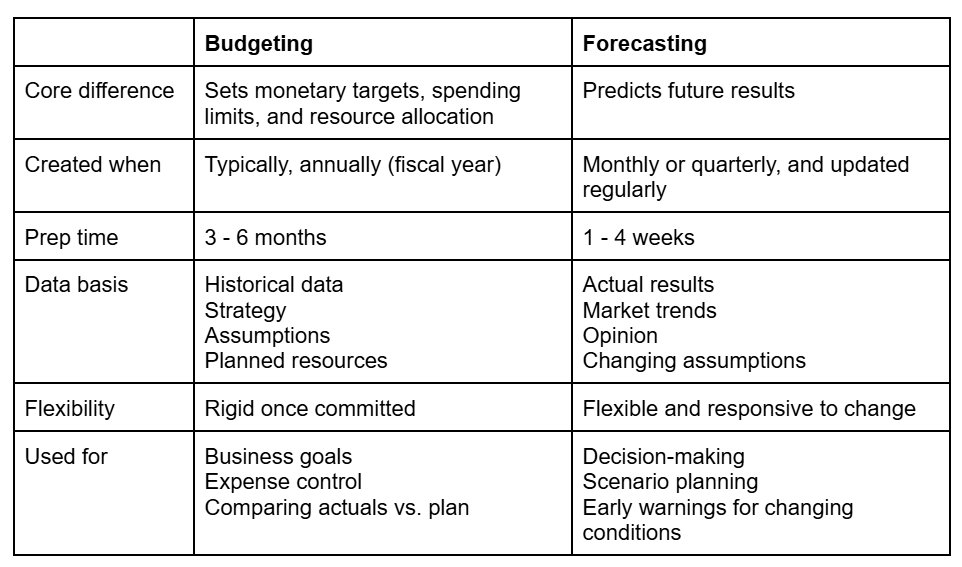
What is Budget Forecasting?
Budget forecasting is a type of forecasting model that uses the budget as a baseline reference point to predict future performance.
Unlike budgeting alone, budget forecasting is flexible, allowing businesses to continuously monitor whether they are still on track financially and to make course corrections when needed.
The budget provides the financial targets and spending framework, while the forecast continuously updates expectations using current data, historical trends, and expected market conditions.
For example, a business may set an annual budget expecting revenue growth of 10%. However, if sales start to slow during the year, budget forecasting can reveal that the original target is no longer optimistic. Leadership can then adjust spending before financial problems emerge.
Many businesses like to use budget forecasting to keep tabs on their cash flow and make more informed decisions. It’s also used in scenario testing, so leaders can prepare for the “what if” situations in case they become a reality.
The Benefits of Budgeting and Forecasting
Here’s a quick breakdown of the main benefits that each financial planning method provides:
Budgeting:
- Expense control: Prevents overspending and keeps costs within limits
- Goal alignment: Connects spending to business priorities
- Resource allocation: Ensures money is directed to the right areas
- Performance tracking: Allows actuals to be compared with targets
- Accountability: Departments are responsible for financial performance
- Long-term planning: Supports business growth strategies
Forecasting:
- Real-time decision-making: Businesses can react to changing conditions
- Cash flow visibility: Predicts upcoming shortages or surpluses
- Early warning system: Identifies financial risks before they worsen
- Greater agility: Businesses can dynamically adjust plans
- Trend analysis: Reveals patterns in revenue and costs
- Scenario planning: Tests different “what if” situations before they happen
How Budgeting and Forecasting Work Together
When used together, budgeting and forecasting create a powerful “plan-and-adjust” system.
The budget is used to set the target, while forecasting continuously shows whether the business is on track to reach it.
This feedback loop nearly always starts with the budget. After the financial expectations for the year are set, actual performance is tracked against budget expenditure.
Then forecasting is introduced. Based on actual results, the business may update its expectations for the remainder of the budget period.
Quick example
An organization might approve its annual budget in January, then perform monthly forecasts as sales or demand fluctuate.
If actual revenue starts running below budget, the forecast will reveal the likely end-of-year result. The business may respond by reducing spend or revising its sales goals so it doesn’t end up out of pocket.
Why You Need Budgeting and Forecasting
Relying only on one of these tools means you lack full visibility over financial management.
Setting a budget without forecasting means it can quickly become outdated when market or business conditions change. For instance, you might continue with aggressive spending when revenue is falling.
Forecasting without a budget makes it harder to measure performance or hold teams accountable for their spending. Without predefined targets, everything becomes reactive instead of proactive.
However, when you use them together, they balance each other out.
Consider a retail business facing a sudden increase in supplier costs. The budget wouldn’t normally account for this change, but the forecast will reveal the impact on margins. The business can then decide whether to raise prices, absorb the cost, or find new suppliers.
Without both tools, the final decision would either be made too late or poorly informed.
This is the reason many businesses are moving away from static planning models. A recent review published in the Journal of Professional Business Review found that organizations relying solely on fixed annual budgets are often less prepared for economic shocks and changing market conditions.
The review concluded that combining budgeting with ongoing forecasting creates a more resilient financial planning process, as businesses can respond to disruptions before they become major financial problems.
Best Practices for Budgeting and Forecasting
Align specific goals with business strategy
Don’t just set a budget because each department needs to spend money. Think about how spending will influence specific goals, such as growth or cost control, and which areas of the business can contribute the most towards them.
Additionally, your goals must be specific and controllable.
For instance, you might say you want to grow revenue by 10%. That’s a great goal, but it doesn’t actually tell you how to get there. Instead, look at the current number of customers, average order value, and the conversion rate.
Those are three aspects that you can use to increase revenue.
When budgeting, instead of saying “increase revenue by 10%,” you could say the business will:
- Use SEO and ads to increase website traffic
- Increase the average order value (AOV) by introducing bundles
- Improve conversion rates by 1%
Now the budget is tied to actual initiatives that can be adjusted. And the beauty is that when you perform forecasting, you can diagnose problems faster.
So, if a forecast reveals that traffic is dropping, that’s a marketing issue, or if the AOV falls, there’s probably a pricing issue.
This transforms your system from reactive to proactive and removes all the guesswork.
Maintain up-to-date and complete data
Your budgeting and forecasting strategy is only as good as the data you feed it. If it’s incomplete, out of date, or just plain wrong, then you’ll end up with budgets and forecasts that don’t work.
Keep all your financial data updated and perform sense-checks or mini audits to ensure it’s complete and correct. Where possible, implement validation workflows so the data has already been checked before it gets fed into a forecast.
Using the right software (see below) will eliminate a lot of these issues because it updates automatically and flags if there are any issues.
Update forecasts on a fixed schedule
Treat forecasts as a non-negotiable part of financial management. Whether you choose to perform them monthly or quarterly, set a rhythm and stick to it.
If you only update forecasts when needed or if a problem emerges, then you’ll just end up firefighting.
Run scenario planning
The fact is that most businesses only look at what has already happened, meaning you’re reacting to actuals. Scenarios flip the situation by answering the “what if” questions. For example, what happens if sales drop by 10% or if costs rise by 5%?
Essentially, you deliberately stress-test your numbers before reality plays out. This way, you already know what could potentially happen and how to protect your business.
It’s best practice to run at least one scenario per month or before you make large decisions:
- Pick one variable per month (sales, cost, hiring pricing, etc.)
- Change it by a realistic percentage
- Observe the impact on your financials
Ditch Excel
Spreadsheets are incredibly labor-intensive and notoriously error-prone. Yes, they are a well-known tool, but once data starts to build up, they can quickly become unmanageable.
The fact is that Excel is a manual process, and spreadsheets take a lot of time to maintain.
When using multiple spreadsheets, you have to link them together and use complex formulas to get the data you want. They’re fragile, and all it takes is a single misskey for the whole thing to crash.
In contrast, modern tools do most of the hard work for you, which leads us nicely on to the next best practice…
Leverage tools and automation
Modern platforms collect and process data on your behalf, which saves a ton of time and effort. And because you’re not relying on manual input, they’re less error-prone.
Most platforms integrate with one another, allowing data to be consolidated without exporting everything to a spreadsheet. Real-time dashboards give you the latest data without having to search for and filter it.
For example, accounting platforms, like QuickBooks, will run forecasts on your behalf, saving you the effort of performing them yourself. And, time tracking software gathers labor and expense cost data alongside budget tracking for actuals vs. budget comparisons.
How to Get Started with Budgeting and Forecasting
If you’re building your first budgeting and forecasting process, the goal is to keep it simple. This way, you can realistically maintain and improve it over time:
- Gather your financial data: Historical revenue, expenses, payroll, debt payments, and cash flow data. Check it for accuracy before you use it.
- Set clear financial goals: Determine what your business wants to achieve over the next 12 months. This could be increasing revenue, reducing costs, expanding operations, or something else.
- Build your initial budget: Create your spending limits and revenue targets based on your goals and expected costs. Start with broad categories (like per department or team) rather than getting too detailed.
- Create a rolling forecast: Use your actual monthly performance data to estimate what is likely to happen for the rest of the year. Be sure to update the forecast regularly so they reflect any changing conditions.
- Compare and adjust: Track where results differ from the original plan. If costs rise or revenue falls, use your forecasting insights to make adjustments before potential issues grow larger.
Final Thoughts
The value of using budgets and forecasting cannot be underestimated. Businesses that use both can adopt a proactive stance rather than a reactive one.
The ability to make faster decisions and spot risk early on is powerful, especially for organizations that want to gain more control and improve their financial insight.
Accurate budgeting starts with accurate data. My Hours lets you track actual time, labor costs, and expenses against your budget in real time. Flexible and customizable reports give you the insights for all your forecasting needs.


