
DOWNLOAD GOOGLE DOCS TEMPLATE
DOWNLOAD GOOGLE SHEETS TEMPLATE
Why Use a Time Off Request Form?
Time off request forms are valuable for several reasons:
- If requests are verbal, there’s no record if a dispute arises. A written time off request form creates documented proof of the request, what type of leave was requested, how many days were needed, and whether it was approved or denied. This paper trail protects everyone involved.
- Using time off forms allows you to quickly see where coverage gaps might appear and which responsibilities need handling while someone is out.
- A good form encourages consistency and fairness, especially if you’ve established a clear time-off policy to accompany the form. It creates a standardized process for reviewing, approving, or denying requests based on business needs rather than impulse or favoritism.
Essentially, using a form doesn’t just protect the business from unforeseen shortages. It also protects the employee because it creates a clear, traceable record of what was requested and what was approved.
Employees aren’t left guessing or chasing verbal promises, and they don’t have to worry about whether their request will be forgotten or misunderstood.
What Should a Time Off Request Form Include?
A time off request form should be simple, clear, and legally sensible.
Here’s what you need to capture:
- Employee details: Name, job title, and department or team (if applicable) are sufficient
- Form submission date
- Start and end dates of the time off
- Total number of work days (or hours) requested
- Type of leave requested: PTO, sick leave, unpaid time off, maternity, etc.
- Manager approval or denial section
- Space for signatures of the manager and employee to confirm the outcome
It can also be very useful (depending on the job role) to include a section for the employee to note down a brief coverage plan. While this isn’t legally required, it does encourage accountability, especially if there will be outstanding deadlines while the employee is off.
For example, it could include who will take over the employee's duties, who becomes the main point of contact, what projects might need adjusting, or what clients should be notified.
A manager's comments section should also be provided. This allows them to explain why a request has been denied or if it needs to be adjusted. Again, this creates a clear paper trail that can prove invaluable if questions or disputes arise months later.
Free Time Off Request Form Template
DOWNLOAD GOOGLE DOCS TEMPLATE
DOWNLOAD GOOGLE SHEETS TEMPLATE
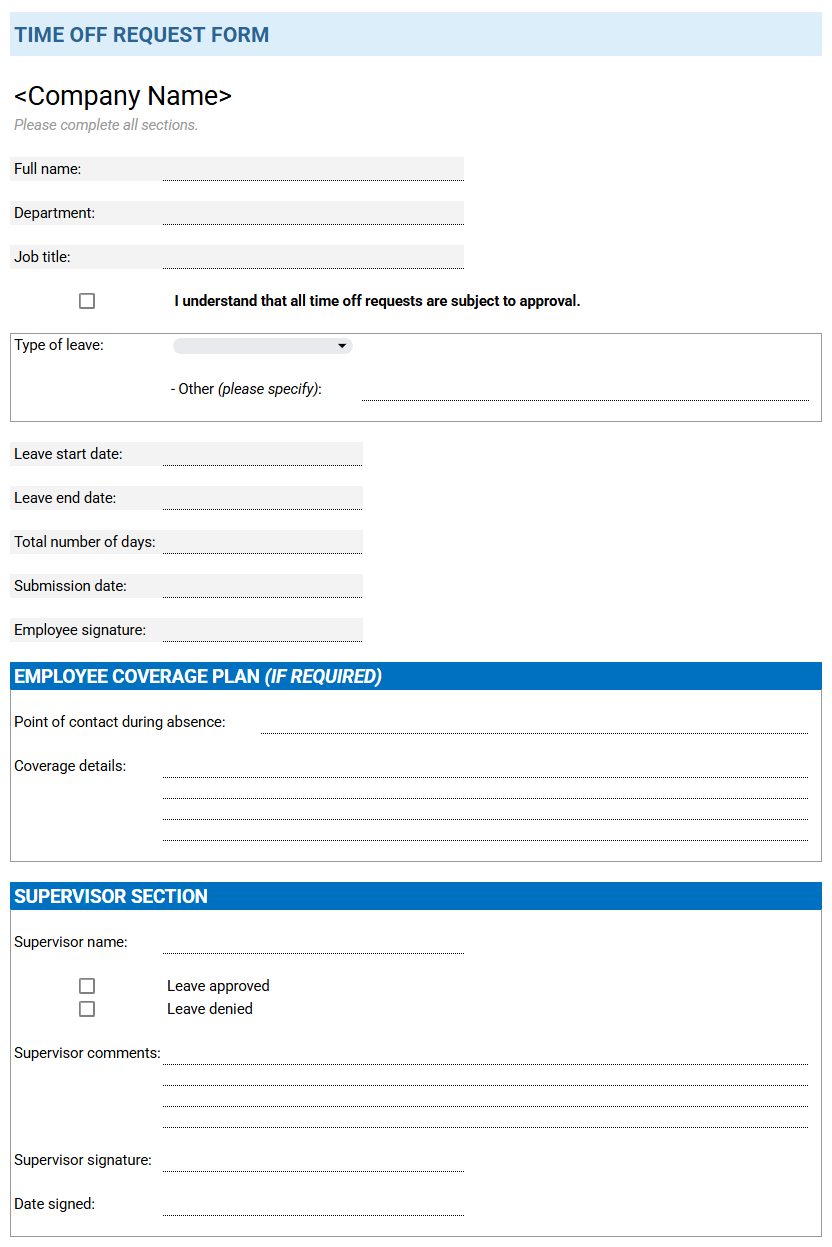
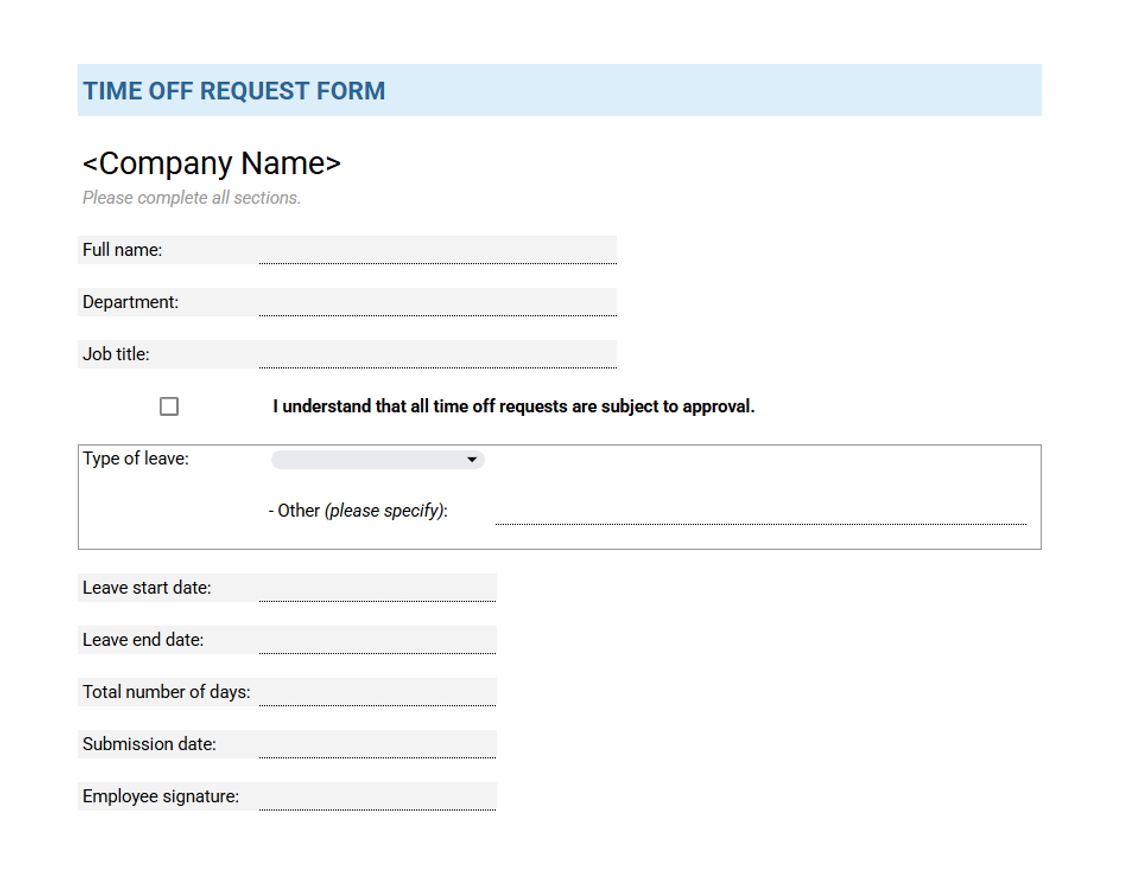
Here’s a clean and simple time off request template suitable for all businesses. Feel free to edit and adapt it to fit your needs.
It includes:
- An employee section for writing their name, job title, department, and time off details
- Handy checkboxes for quickly specifying the type of time off
- A work coverage section (you can delete this if you don’t need it)
- A supervisor section for approving or denying the time off request
- Space to add more details if required
- Form submission and completion dates, along with signatures from both parties
Best Practices for Creating a Time Off Request Form
Your employees should know exactly what to do with the form when they want to submit a request.
To keep the process watertight, follow these tips:
- Define how the form should be submitted. We recommend an electronic method because it creates a digital paper trail, preventing forms from getting lost.
Pro tip: Set up a dedicated inbox and email address for receiving time off requests.
- Stick to the submission method. Only accept request forms that have been submitted via the defined method.
- Train employees on how to use and submit the form.
- Keep the form accessible and easy to find. Store it in a shared drive or HR portal that employees already use. Ensure your time off policy is available alongside it.
- Keep the form simple. Don’t make it lengthy or complex. Employees shouldn’t have to write lengthy explanations about why they’re requesting time off, nor should they have to justify the request in any way.
- Apply the same process to all employees. It should make no difference if they’re an executive or an admin assistant. Using the same form and approval process prevents favoritism claims.
- Retain all request forms. Keep that paper trail solid by storing the forms like you would any other employee records.
What Should a Time Off Request Policy Include?
Besides the request form itself, you must also have a clear time-off policy to keep the process fair and transparent.
Having one removes the guesswork on what is and isn’t permitted, plus it covers you if anyone disputes the outcome of their request.
Here’s what you must define:
Types of time off offered
Clearly list the types of leave available, such as PTO, vacation, sick leave, unpaid time, etc.
Employees should be aware of the available options before submitting a request.
Specify how time off is requested
Outline how employees must submit requests, including which form to complete, where to send it, and who to send it to.
Define a minimum notice period. For instance, you might require two weeks' notice for vacation requests or a month's notice for longer absences
You should also include the maximum duration that an employee can request. For instance, you might state that employees can only request a maximum of one week of PTO at any given time.
Approval/denial process and criteria
Explain how decisions around time off are made. For example, you might use a “first-come, first-served” process or determine time off based on coverage needs.
Also, detail the reasons for which a time off request can be denied. These must be very specific (like staff shortages or busy periods) so the manager can’t deny requests based on personal feelings or whims.
Blackout dates
Depending on the industry, you might have periods that require all hands on deck. During these times, employee time off must be strictly limited to emergencies.
Clearly identify these periods to set expectations and prevent frustration when requests are denied.
PTO accrual, rollover, and usage
Many organizations that provide PTO require employees to accrue it over the course of the year. If this is true for your business, clearly explain:
- How PTO is earned and how much time is accrued each month
- Whether or not PTO rolls over to the next year
- If PTO does not roll over, specify the deadline by which it must be taken
- How much PTO can be taken at any one time (for example, one week max per request)
Coverage expectations
Clarify if employees are expected to help arrange coverage for their duties, and if so, who those individuals will be.
Sick and emergency leave rules
The time off request form won’t work for unexpected absences. Therefore, address how this type of time off should be reported and what documentation (if any) is required.
This maintains flexibility without sacrificing accountability.
Consequences for taking unapproved or undocumented time off
Be upfront about any disciplinary procedures that will take place if an employee takes time off without gaining approval or reporting an unexpected absence.
For instance, it’s common to have a verbal warning for a first instance, escalating to dismissal for repeated and sustained instances.
Legal Considerations for Time Off Requests
Time off requests in the US are governed by a mix of federal and state laws, along with your organization’s policies.
Unlike many other countries, there is no single, universal rulebook, which means you need to understand the time off laws for your particular location.
Here are some important things you need to know from a legal standpoint:
- Federal law does not mandate vacation leave or PTO. These benefits are usually created by the employer and defined in the employee’s contract.
- Employers can approve or deny PTO based on business needs. However, decisions must be consistent with written policy and non-discriminatory (not based on protected traits).
- Under the federal FMLA, employers of 50+ employees must provide up to 12 weeks of unpaid leave for qualifying conditions to eligible employees. This leave is also job-protected.
- Many states now require that employers provide a minimum number of days for paid sick leave and restrict the denial of requests. Typically, sick leave is accrued at a rate of one hour per 30 worked; however, this can vary by state.
- Other legally mandated time off can include jury duty, voting, victim-related leave, and certain military leave.
- When federal and state time off laws overlap, the employer must apply whichever rules are more beneficial to the employees.
To understand more about time off rules, read Labor Laws by State.
To ensure you comply with relevant laws, apply the following legally sound practices:
- Use clear written policies on how to request time off
- Apply reasonable notice requirements
- Use consistent documentation rules (like when to provide a doctor’s note)
- Accurately track leave so pay and job-protection entitlements are correctly applied
How to Handle Time Off Requests Fairly and Consistently
It’s up to you, as the employer, how to handle time off requests. However, whichever method you choose must be applied fairly and consistently to all employees.
So choose an approval framework and stick to it. Options include:
- First-come, first-served: Whoever gets their request in first for a particular date range gets it approved. To avoid everyone putting in their requests at the start of the year, apply minimum and maximum notice periods for submitting forms.
- Role-based coverage: Requests are approved based on whether essential roles remain covered. This option is better for shift-based roles like retail, hospitality, and operations-heavy teams.
- Seniority-based approval: Employees with longer tenure receive priority when requests overlap. Use with caution, as this can hurt morale if used too rigidly, and newer employees may feel like they can never get the time off they want.
- Manager discretion: Managers approve or deny requests based on business needs and timing. Enforce strict approval/denial criteria to avoid perceived favoritism.
- Rotational system: For high-demand leave periods (holidays, summer, etc.), use rotational priority so each employee has a fair chance at getting their preferred dates.
- Capacity-based approval: Only a set number of employees can be out at the same time. Once the cap is reached, further requests will be denied.
Tip: Time tracking will help you with capacity planning.
Many organizations prefer to take a hybrid approach and use a combination of methods. Most commonly, first-come, first-served, along with role-based coverage or capacity-based approval.
This balances fairness with the reality of business demands and works for most types of business.
Other best practices for ensuring a fair and consistent application include:
- Documenting all time off decisions to avoid disputes
- Setting clear rules for overlapping requests
- Sticking to your chosen framework when multiple requests for the same period occur
- Using blackout periods for certain dates so you don’t get requests during critical business times
Digital vs. Paper Time Off Request Forms
The type of form you choose to use matters more than you might expect.
Remember, time off request forms act as evidence of the decisions made and the reasoning behind them. So you need to keep this documentation in case you have to refer back to it at any point.
Because of this, we don’t recommend using a paper time off request form. They’re too easily lost and are harder to keep track of, resulting in incomplete records.
If you insist on using a paper form, make sure a digital copy is scanned, uploaded, and filed appropriately.
Better yet, invest in a digital system so everything from the form to the storing of documentation has a footprint.
It doesn’t need to be complicated. As we referenced earlier, setting up a dedicated inbox is a straightforward system. Using spreadsheets is another way to keep information organized and in one place.
If you use HR software, you’ll likely find it has tools for setting up time-off request workflows and keeps an audit trail of everything.
Similarly, time tracking software keeps everything clearly documented. It maintains an audit trail, and you can upload copies of paperwork to time logs so that records are kept intact.
Additionally, using the reporting feature in time tracking software allows you to quickly spot patterns and trends around time off and workloads. By analyzing this information, you can shape your time off policies to better fit the work environment.
Common Time Off Request Mistakes to Avoid
Even with clear policies and a solid time off request form, mistakes can still happen.
These errors are not usually due to the process itself being flawed. Rather, they arise because of how the process is handled day-to-day by managers and employees.
Therefore, familiarize yourself with these common mistakes so you can take care to avoid them:
- Relying on verbal approvals: Many small companies feel like they don’t need an official time-off request process. But verbal approvals leave no record or trace of proof. If it’s not documented, it didn’t happen. So get absolutely everything in writing.
- Treating similar requests differently: Approving one request and denying another without a clear, documented reason invites disputes and a potential legal risk.
- Assuming submission equals approval: Employees sometimes assume that simply submitting the request form counts as approval. Make sure that your workers understand that the process includes a waiting period and an explicit response. Provide training and clear documentation that spells this out in terms anyone can understand.
- Failing to plan for coverage: Coverage planning should be part of the approval process, not an afterthought. Constantly denying time off or retracting approvals leads to overworked and frustrated staff, so incorporate it into your time off strategies.
- Making exceptions: If you bend the rules, it can quickly become a precedent, so avoid it as much as possible. If an exception is necessary (medical emergency, for example), clearly document the reason.
- Not communicating decisions early: Delayed or unclear responses create confusion and resentment. Employees should know when to expect a decision and receive a clear yes or no.
Frequently Asked Questions
How do you write a time off request?
A time off request should be clear, professional, and follow the organization’s established policies and processes regarding time off.
Employees should submit their request using the approved form or system, including the dates requested, the type of leave, and any required notice.
Can my boss deny my time off request?
Yes, your boss can deny a time-off request if it’s related to business needs, staffing levels, or policy rules. However, your boss cannot deny a request for legally-protected leave if you qualify under applicable laws.
How to fill out a PTO request form?
To fill out a PTO request form accurately, complete all the required fields, including your name, dates requested, number of days, and the type of leave. You may also have to work out a coverage plan before submitting your request.
Don’t assume that form submission counts as approval. Wait until your supervisor has explicitly approved the request before making any commitments or plans.
Can an employer fire you for requesting time off?
An employer generally cannot fire or retaliate against a worker for requesting legally-protected leave. However, in “at-will” employment states, they can fire you for almost any reason that is not illegal, including taking time off without approval or skipping work.
Are employers required to offer PTO in the US?
Employers in the US are not required to provide paid time off. If a business chooses to offer PTO, it must develop its own written policy and comply with state and local laws.
How far in advance should employees request time off?
Advance notice for requesting time off is dependent on the organization’s policies. Many businesses require anywhere from a week to several months of notice for planned time off. Emergency or sick leave tends to be handled differently, but advance notice expectations should be clearly outlined.
What if an employee takes time off without approval?
If an employee takes time off without approval, the appropriate response is to follow company policy regarding disciplinary procedures. This may include a denial of pay for the absence or dismissal in extreme cases.


