

How Many Working Days in a Year: 2026 Overview
If we assume the average person works five days a week, then there are 261 working days in 2026.
Here's the math behind that number:
- 5 (weekly workdays) X 52 (weeks in the year) + 1 = 261
The “extra” day is added because a calendar year runs 52 weeks plus one additional day. If that day (which is taken as January 1) falls on a weekday, it’s counted as a workday. If it falls on a weekend, it’s excluded.
In 2026, January 1 falls on a Thursday, so it is counted as a workday.
Now, bear in mind that the above number does not take federal public holidays into account, which total 11 throughout the year in the US.
Many businesses close on these days, and if that’s the case for your organization, then the figure reduces to 250 working days in 2026.
Working Day Calendar 2026
If you’re wondering how many days you’re likely to work in each month of 2026, here's what 2026 looks like:
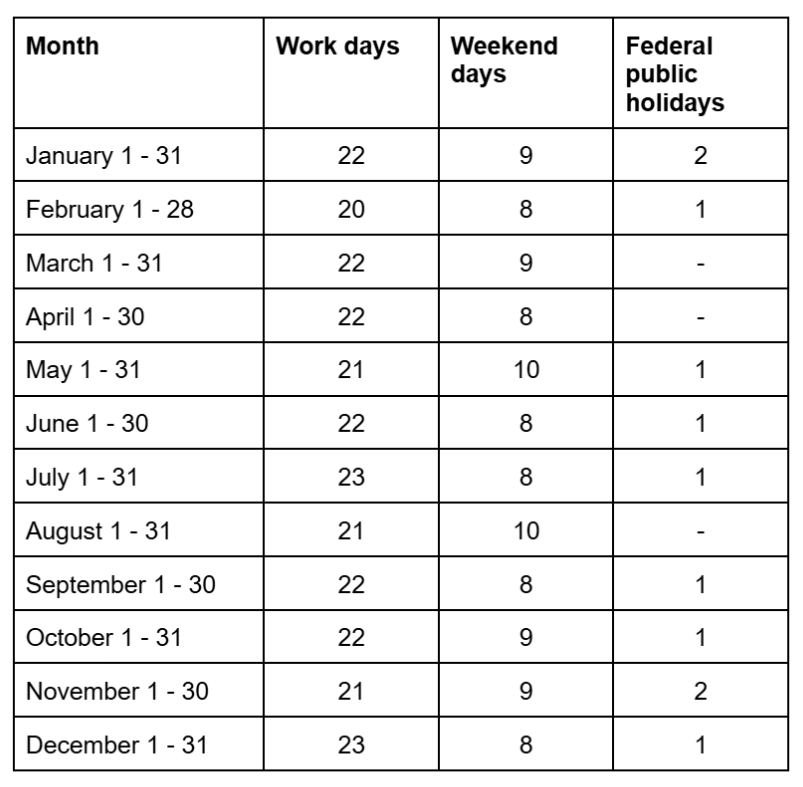
May 2026 gives you the most time off with 10 weekend days, bringing your total work days down to just 21 (or 20 if you include the public holiday).
December and July offer the most working days at 23 each, making them your busiest months if you're trying to maximize billable hours or push through major projects.
The federal public holidays fall on the following dates in 2026:
- New Year’s Day: January 1 (Thursday)
- Birthday of Martin Luther King, Jr.: January 19 (Monday)
- Washington’s Birthday: February 16 (Monday)
- Memorial Day: May 25 (Monday)
- Juneteenth National Independence Day: June 19 (Friday)
- Independence Day: July 4 (Friday)
- Labor Day: September 7 (Monday)
- Columbus Day: October 12 (Monday)
- Veterans Day: November 11 (Wednesday)
- Thanksgiving Day: November 26 (Thursday)
- Christmas Day: December 25 (Friday)
How to Calculate Your Work Days in 2026
The numbers above work perfectly if you follow a standard Monday-through-Friday schedule with regular hours.
But what if you work weekends, pull six-day weeks, or have paid time off you plan to use?
Here’s how to calculate an accurate total:
Calculate Total Working Days
To get your total number of working days for 2026, perform the following calculation:
- Number of workdays you work per week X 52
Now, remember that a year is 52 weeks plus one day (January 1). In 2026, January 1 is a Thursday. So, if you work Thursdays, add the day to the total. If it’s one of your days off, exclude it.
Subtract Federal Public Holidays
Next, do you work during public holidays or take them off?
If you work them, you don’t need to perform any calculations here. If you take them off, subtract 11 days from your current total.
Deducted Paid and Unpaid Days Off
Don’t forget to subtract any PTO or unpaid time off that you are likely to take off during the year.
For instance, if you get 15 days of PTO per year, subtract that amount from the total.
Federal analysis shows that workers take an average of five sick days each year. Therefore, you may want to give yourself a conservative estimate and also factor in potential sick days for 2026.
If so, subtract these from the total.
Working Example
Here’s a quick example to show you what all the calculations look like together:
- 6 workdays per week
- 6 X 52 = 312
- + January 1 = 313
- 11 Public holidays: Not worked
- PTO: 10 days per year
- Sick leave: 5 days per year
- Final calculation: 313 - (11 + 10 + 5) = 287 working days in 2026
What’s the Grand Total?
You may have started out with a ton of working days in 2026, but after factoring in PTO, sick leave, and public holidays, the true figure is probably much lower.
That final total is the number that matters.
Use it as your baseline for planning throughout the year. And if you throw time tracking into the mix, you’ll gain even more clarity about how you spend your working hours and where your time actually goes.
The Benefits of Calculating Work Days in a Year
As we have found out, although the year has 365 days, not all of them are productive.
Knowing the true number of workdays is worth it for several reasons.
Realistic Planning
A three-month deadline sounds ample, but when you factor in the weekends and other time off, it suddenly becomes a lot tighter.
When you have an accurate number of workdays in front of you, it’s a lot easier to plan around the time that’s actually available.
You can set deadlines that are realistically achievable and spread out workloads so it doesn’t all pile up right before a long weekend.
Better yet, calculate workdays and pair them with time tracking. Once you start tracking deliverables, you can base future deadlines on past outcomes.
Forecast Income
If you bill by the hour or receive an hourly wage, then every second counts. Knowing how many days you can work helps you forecast income more accurately.
For instance, February only has 20 working days, while January has 22. Therefore, you might reduce spending in February to match the lower income, or you might take on more hours in January to have an extra income.
Tracking billable hours is a great way to see your accumulated income for a particular month. As billable time is tracked in real time, you can tell at a glance if you’re on track to meet your target or if you need to ramp up the hours.
Distribute Workloads
When you calculate workdays per month, you can quickly see why certain months, like December, are productivity traps.
This lets you plan lighter workloads when time is tight and schedule larger projects when you know you have ample time.
Manage Capacity
Similarly, knowing each month’s workdays tells you how much capacity you or your team likely has.
When someone comes along with an extra task or wants to launch a new project, you have the foresight to push back or schedule it for later.
Time tracking is highly beneficial for managing capacity and workloads. By comparing current projects against past projects, you can see the resources you are likely to need and plan accordingly.
Additionally, it allows you to spot bottlenecks (tasks taking longer than they should) and look for ways to adjust processes to make them more efficient.
Accurate Goal Setting
Big annual goals can feel overwhelming when they don’t have a specific endpoint.
Saying “I want to achieve this in 2026” is great, but without determining when and in what timeframe you'll tackle it, the goal often falls by the wayside.
Breaking down your goals by real working days makes them feel manageable and achievable. Instead of a large void of time, you’re looking at small chunks of progress tied to the actual time you can work.
Improved Time Off Schedules
There will always be deadlines, people taking time off sick, and projects piling up.
But workers need and deserve to take breaks. Otherwise, burnout is a very real possibility.
Calculating workdays and holidays allows you to map out the year and schedule time off so each worker can take a break without leaving you shorthanded.
A time tracking tool will help you keep on top of time off. You can use the reporting feature to analyze absence patterns and make changes so time off policies are fair for everyone.
Frequently Asked Questions
How Many Weekdays in a Year?
A standard year has 260 or 261 weekdays (Monday - Friday).
A year is 365 days, which is 52 weeks + 1 day. 52 x 5 weekdays = 260 weekdays in total.
The extra day can be counted if it falls on a weekday.
For 2026, there are 261 weekdays because January 1 (the extra day) falls on a Thursday.
How Many Days in a Year Without Weekends and Holidays?
Excluding weekends, a year contains 260 to 261 days. The US observes 11 federal public holidays, which means the total days in a year (without weekends or holidays) is 249 - 250.
For 2026, there are 250 days that fall on neither a weekend nor a public holiday.
How Many Business Days in a Year?
Business days are considered weekdays (Monday to Friday), excluding public holidays and weekends.
In a standard year, there are 260 or 261 weekdays. If you subtract the 11 US federal public holidays, you are left with 249 or 250 business days in total.
Other countries have a different number of public holidays, so this figure varies depending on your location and how many official holidays your country recognizes.
How Many Working Days in a Leap Year
A leap year has 366 days, which equates to 52 weeks and two days. That means there can be 260 - 262 working days in a leap year.
We can work this out by performing the following calculation: 52 x 5 weekdays = 260 weekdays. Then, it depends on which days January 1 and February 29th fall on.
If they fall on a weekday (Monday - Friday), we add them to the total. If they fall on a weekend, we exclude them from the total.


