

What is Profitability and Utilization?
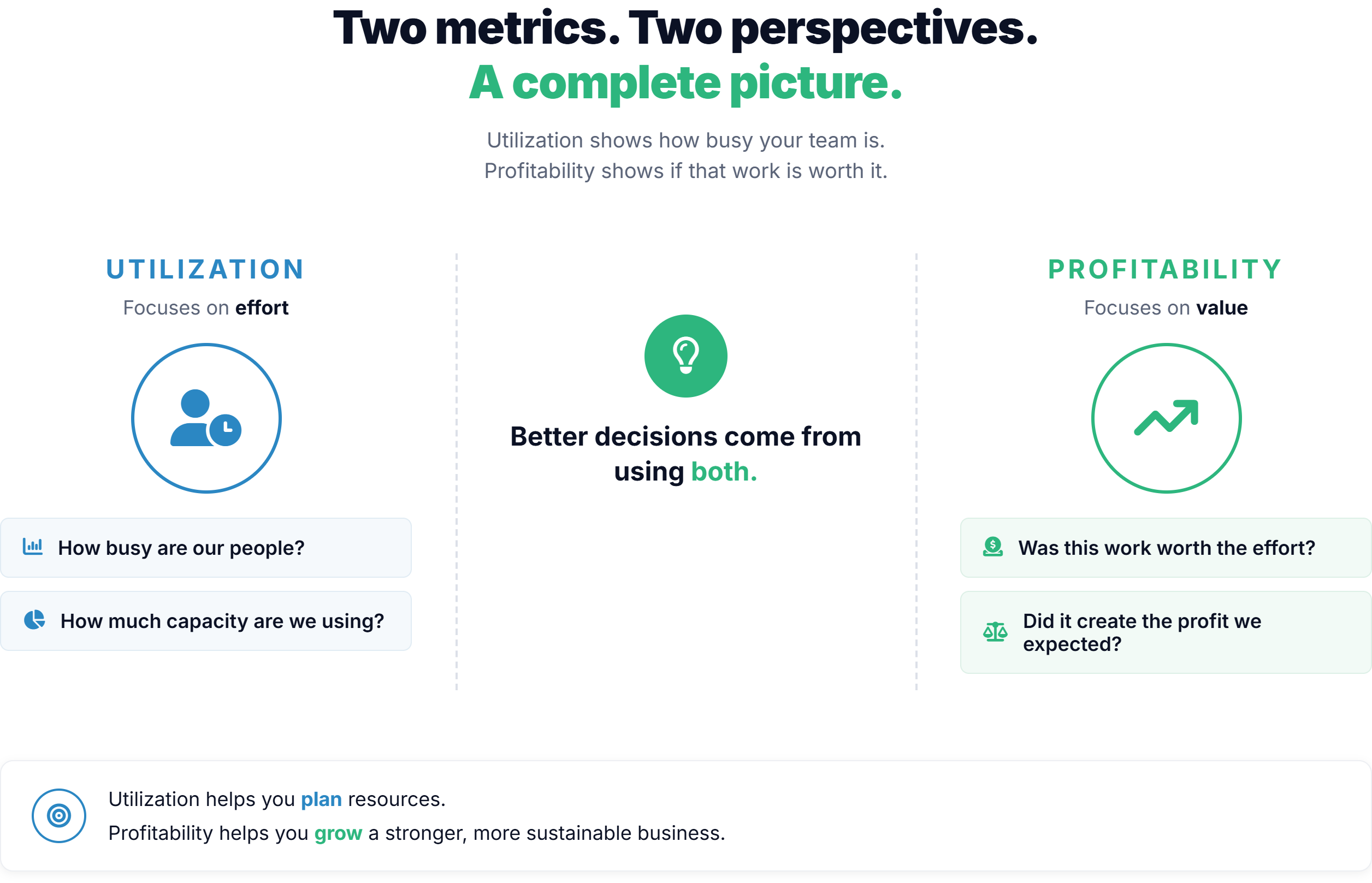
Although these terms are often discussed together, they answer two completely different business questions.
Utilization asks: How much of our available capacity is being used?
Organizations use utilization to understand how effectively they’re using their workforce. It helps identify spare capacity, shortages, and if there are any resource planning issues.

→ So, if a worker has 160 available working hours in a month and spends 128 of them on billable client work, their utilization rate is:
- (128 / 160) × 100 = 80%
Profitability asks: After everything it costs to deliver this work, how much money are we actually making?
To arrive at the answer, profitability takes a much broader view and considers factors like labor costs, expenses, overheads, pricing, and more.
Platforms like My Hours make the job easier by bringing utilization and profitability data together in one place. This makes it easier to monitor both metrics without relying on separate spreadsheets.
The Metric Trap
Imagine walking into a Monday morning team meeting. Every employee is fully booked for the next six weeks. Calendars are full, and worker utilization sits comfortably above 90%. On paper, everything looks healthy and promising.
Yet, when it gets to the end of the month, profits are down. Cash flow is tighter than expected, and several projects have not delivered their expected margin. Despite everyone working flat out, the business is not seeing the results it expected.
This scenario is more common than you think.
One study from Columbia Business School found that profit margins decreased when a firm approached full capacity and increased when it experienced idle capacity.
How come?
While utilization tells you that people are busy, it tells you almost nothing about whether that work is actually creating value.
It can’t answer business-critical questions like:
- Is the work generating healthy margins across employees, projects, and clients?
- Are high-cost team members being used where their expertise creates the most value?
- Do our billable rates properly reflect what it costs us to deliver the work?
- Once overhead is included, how much profit does this level of utilization actually produce?
The takeaway here isn't that high utilization is bad, it's that capacity alone doesn't determine profitability. The commercial decisions you make around pricing, staffing, and project delivery matter just as much.
Why Utilization Looks So Good
Businesses love to use the utilization metric because it’s simple.
Managers can see utilization almost instantly from timesheets. It produces a single percentage that’s easy to compare across departments or groups of workers.
It also feels actionable. If utilization drops, managers can quickly look for more work to keep everyone busy.
High utilization also feels productive, and that produces a sense of control. From an operational perspective, it’s desirable to have everyone engaged in an activity.
Because utilization looks so good, many organizations, especially service-based firms, build performance targets around this metric.
But as we’ve already discussed, utilization can’t distinguish between valuable work and unprofitable work. And this is the key problem with relying on it by itself.
How Profitability Tells the Real Story
Profitability forces businesses to ask a much harder question: Was this work actually worth the effort?
Instead of focusing purely on time spent, profitability examines the financial outcome of that work.
To get to the conclusion, businesses must look deeply into pricing, staff roles, scope, client mix, and expenses. Here are some examples to explain what we mean:
- Pricing: Suppose an agency estimates a website project will require 100 hours and charges $15,000. If the project ultimately takes 180 hours due to revisions and scope adjustments, those extra hours dramatically reduce the project’s margin, even though worker utilization has increased.
- Staff roles: Imagine assigning a senior executive who costs the business $120 per hour to perform work that could have been completed by a junior consultant costing $45 per hour. The project still gets delivered, utilization stays high, but unnecessary labor costs have eaten up the profit.
- Scope: Many businesses continue absorbing small requests without adjusting fees. Each addition is minor, but combined, they result in a significantly higher cost for delivering the project. Meanwhile, the revenue remains fixed.
- Client mix: Some long-standing clients negotiate big discounts, require extended support, or consistently generate scope creep. Teams may spend hundreds of hours servicing these clients for very little profit. At the same time, potential new clients are ignored in favor of more “reliable” income.
- Expenses and overheads: Travel, software fees, subcontractors, equipment, and even insurance and rent all contribute to the true cost of delivery. Even if a team achieves excellent utilization, if expenses aren’t monitored and managed, they’ll swallow the profits.
As you can see, profitability makes it clear why a project might not have delivered as expected. Yes, utilization plays a key role, but profitability is where you gain clarity.
Should You Ditch Utilization in Favor of Profitability?
At this point, profitability may seem like the more useful metric. But that doesn't mean utilization should be abandoned. The two metrics answer different questions, and together they provide a complete picture of business performance.
Consider a team with relatively low utilization. At first glance, this might seem like a problem. However, profitability data may reveal that they're focusing on high-value projects with strong margins, meaning the business is generating healthy returns despite not operating at maximum capacity.
The opposite situation is just as common. A team may be operating at 95% utilization, but profitability reports show margins steadily declining. Looking deeper might reveal underpriced projects, excessive write-offs, or a different problem.
When both metrics are viewed together, leaders can make better decisions. Instead of trying to keep everyone busy, they can ensure that available capacity is being used on the work that delivers profitability.
In short, the goal isn’t to maximize utilization at all costs or to chase the highest possible margins. What you must do is find the right balance between maintaining a healthy capacity and consistently delivering profitable work.
How to Measure Utilization for the Most Beneficial Results
Utilization percentages on their own tell you very little, except that your team is or isn’t busy.
To make the metric useful, you have to measure utilization at multiple levels.
Break the data down into different areas of the business to identify trends and spot issues before they reduce profits.
Therefore, you should track utilization by:
- Individual employee
- Team or department
- Individual projects
- Each client
- Each service
Next, within each group, look at the split between billable/profitable work vs. non-billable “busywork” (admin, meetings, business development, etc.).
Separating different types of non-billable work provides much greater visibility into where time is spent and helps identify opportunities to improve efficiency without eliminating essential activities.
The Profitability and Utilization Balance Across Industries
Although the principle remains the same, the balance of profitability vs. utilization does vary depending on the industry.
Here are some examples of these differences:
- Professional services: High utilization rates are desirable within firms that rely on billable hours because employee time is the primary product being sold. However, these businesses still need profitability to understand if work is priced correctly, staffed efficiently, and protected from excessive write-offs.
- Creative agencies: Although they come under the professional services banner, they typically deal with fixed-fee projects. This means workers may achieve high utilization while repeatedly exceeding budgets. In this scenario, profitability depends more on cost management and careful scope control than on maximizing billable hours.
- Software companies: Much of the development work occurs before revenue is generated. A development team may have relatively low billable utilization while building a product that produces recurring subscription revenue for years. Measuring utilization alone here would significantly undervalue the work being performed.
- Construction and engineering: There are a lot of additional costs and expenses to consider (materials, equipment hire, subcontractors, etc.) alongside labor utilization. A project might keep everyone occupied, but overruns in expenses eliminate much of the expected profit.
Essentially, organizations must recognize that utilization should always be interpreted within the context of their business model rather than treated as a universal benchmark.
Signs You’re Overusing the Wrong Metric
Focusing too heavily on one metric can create the illusion of success while performance declines.
Some common warning signs of overusing utilization include:
- Revenue continues to grow while profit margins remain flat or decline
- Teams consistently operate at high utilization, but cash flow remains tight
- Projects regularly exceed their original budgets despite appearing productive
- Staff are constantly busy, yet managers struggle to identify the most profitable clients
- Discounts, write-offs, and scope creep become increasingly common
- Hiring increases to maintain capacity, yet profitability doesn’t improve
If several of these warning signs appear simultaneously, it’s often a sign that you are valuing activity rather than measuring value.
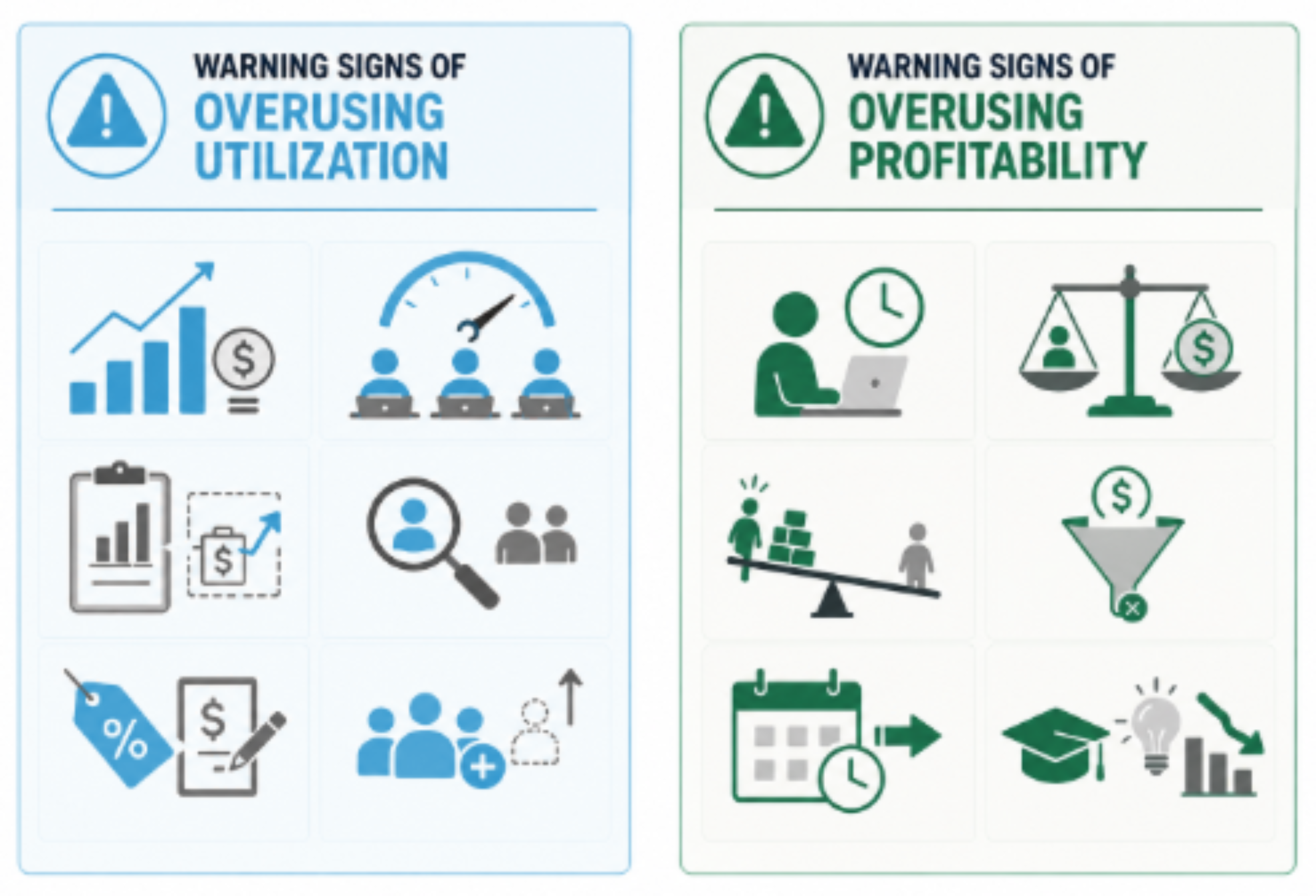
At the opposite end of the scale, over-relying on profitability comes with its own set of red flags:
- Employees regularly have spare capacity despite strong profit margins
- Customer service declines as managers prioritize the high-margin clients
- Some staff are overloaded with high-value projects while other workers remain underutilized
- Revenue growth stalls because the business becomes overly selective about the work it accepts
- Managers delay hiring to project margins, resulting in team burnout and missed delivery deadlines
- Investment in training or innovation is reduced because these activities temporarily lower profitability
If you spot these signs, it may indicate that you’re maximizing margins at the expense of long-term growth and operational resilience.
How Time Tracking Software Connects Profitability and Utilization
Modern time tracking platforms make it extraordinarily simple to understand how utilization is affecting profitability.
Instead of just recording hours worked, many systems track time alongside labor rates, billable rates, budgets, and expenses.
Plus, it breaks down time into categories (billable, non-billable, etc.), so you can see exactly where time is going.
All this data can be pulled into a report that gives you a clear picture of project performance while work is still underway, rather than after the fact.
For example, the data will reveal projects where utilization is high, but margins are falling short because labor costs are exceeding estimates. Or that too many non-billable hours are being absorbed.
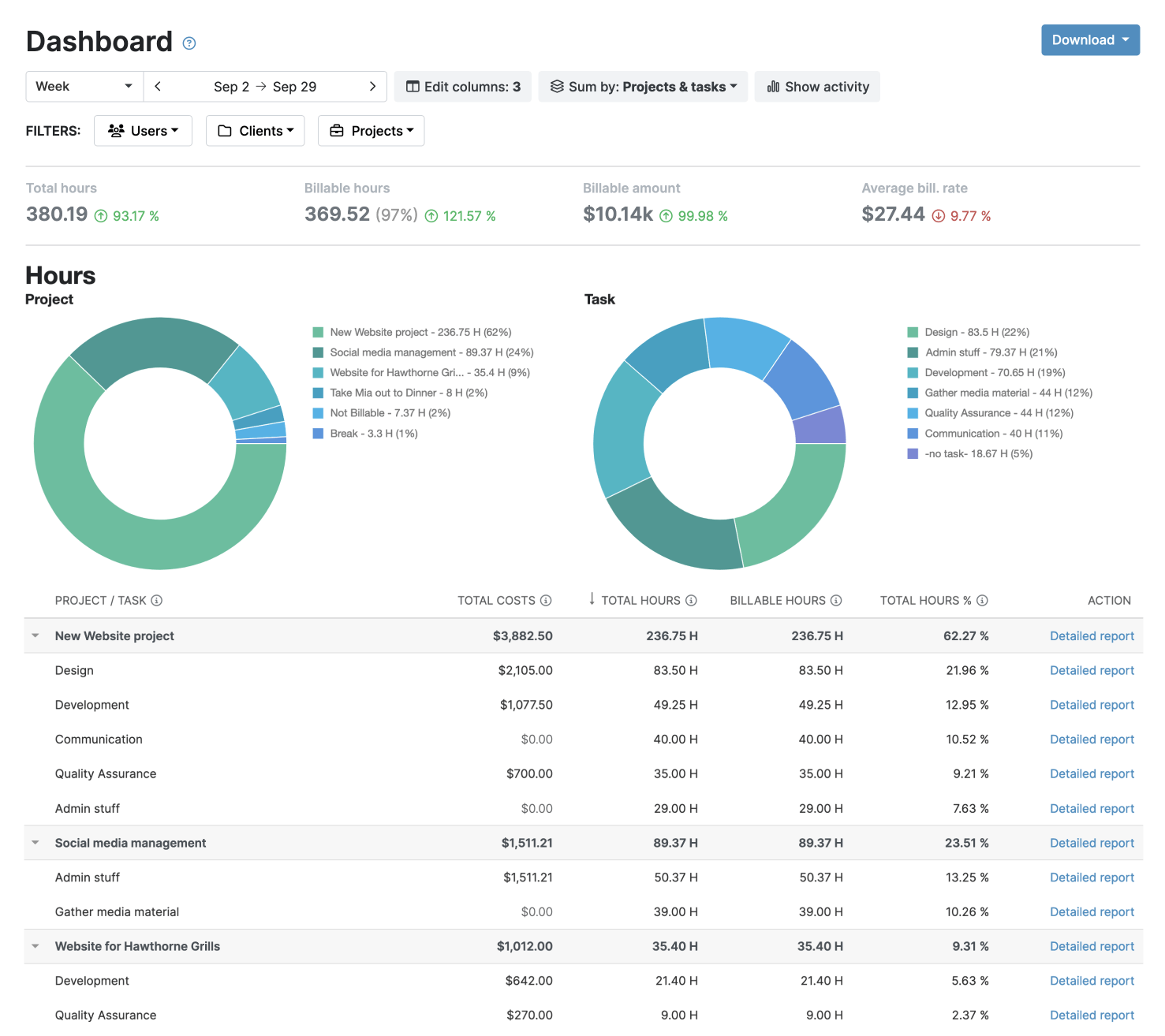
Project dashboards can also highlight which clients are consistently generating strong margins compared to those that eat them up. You can also look at staff distribution to see if high-cost workers are spending their time on low-value tasks.
By bringing operational and financial data into one centralized system, you can spot these issues quickly and make adjustments in real time. This moves you beyond simply tracking activity and toward work that supports profit.
Five Questions to Ask When Profits Don't Match Activity
If your team is working at full capacity but profits are declining, it's time to find out why.
1. Is the project priced high enough to cover labor, expenses, and overhead?
It’s not enough to just consider billable hours or labor rates. Review whether your pricing accurately reflects the true cost of delivering the work, not just the hours spent completing it.
2. Are you using the right mix of staff?
Review how work is distributed across your team.
Senior staff should focus on complex, high-value activities where their expertise has the greatest impact. Routine tasks can be delegated to lower-cost employees without affecting quality.
3. Which clients consistently generate the strongest margins?
Rather than looking only at revenue, compare the profitability of each client.
This can reveal accounts that consume significant resources while delivering relatively little profit, as well as those that deserve greater investment.
4. Are write offs, discounts, or scope creep reducing realization?
Look for projects where billable hours are regularly written off, discounts are applied, or additional work is completed without updating the project scope.
Small adjustments made throughout a project can have a significant impact on the final margin.
5. If utilization increased by 10%, would profit also increase?
If team utilization increased tomorrow, would it generate additional profit or simply increase delivery costs?
If increasing utilization doesn’t solve profitability, then your issue lies within one of the previous four questions, not with capacity.
Bottom Line
Utilization and profitability aren’t competing metrics. They’re complementary ones.
The most successful organizations don’t simply aim to keep everyone busy, nor do they chase profit at the expense of long-term growth. Instead, they use utilization to guide resource planning and profitability to validate that the work is worth doing.
And when you combine both metrics with accurate time tracking and reporting, you can make better decisions in real time, before profits start to decline.
To see how My Hours can reveal utilization and profitability in your organization, sign up for a 14-day free trial.


