
What Is Data Residency and How Is It Different from Compliance?
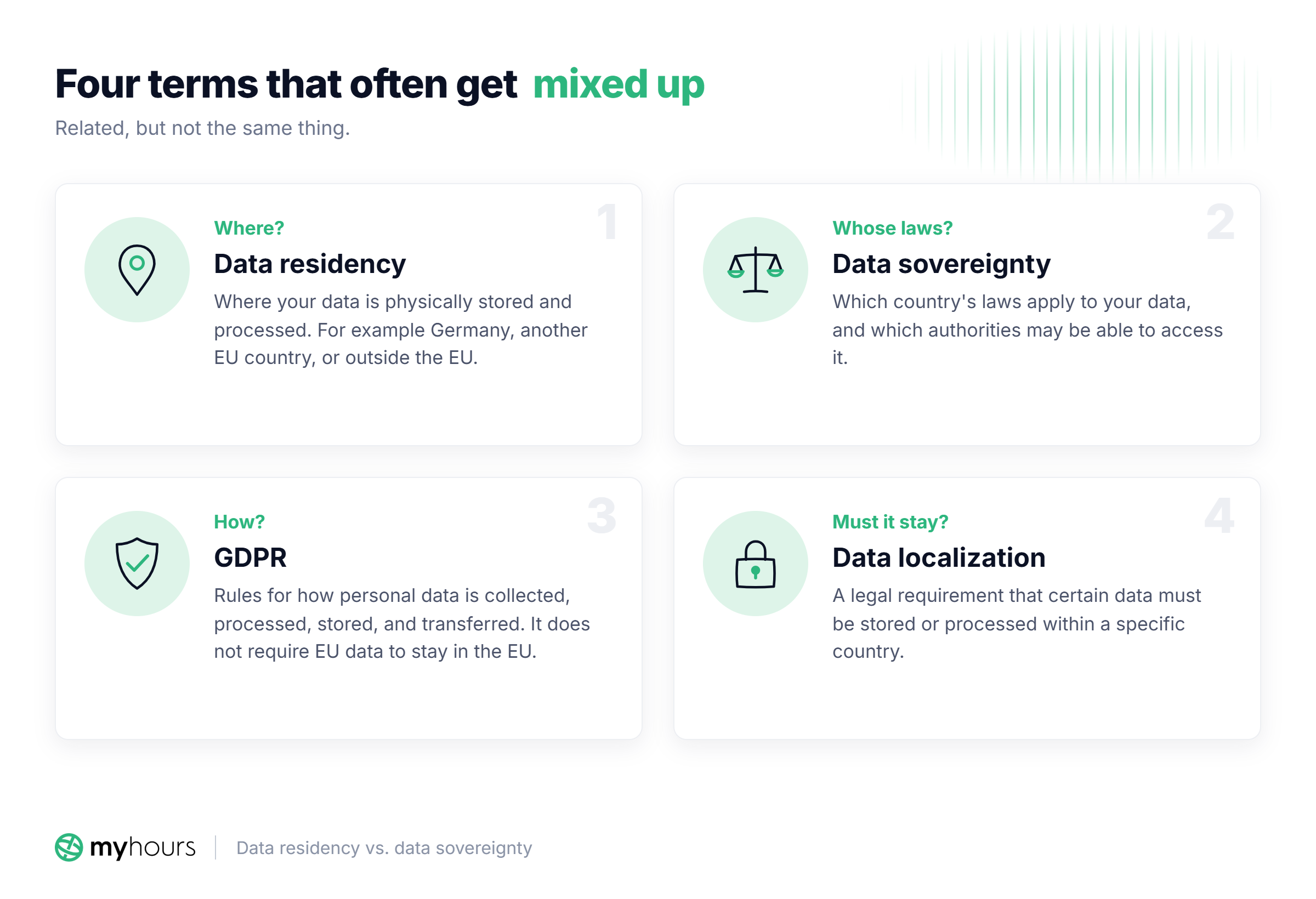
Data residency is about where your data is stored and processed. For example, a time-tracking platform may store your data in Germany, another EU country, or outside the EU.
When we talk about data residency, we also need to discuss data sovereignty. This is about which country's laws apply to your data and which authorities may be able to access it.
People also tend to confuse data residency with GDPR. They are related but distinct. GDPR governs how personal data is collected, processed, stored, and transferred, but it does not require EU personal data to remain within the EU.
There’s also data localization, which is different from both. This refers to a legal requirement for certain data to be stored or processed within a specific country.
Who Needs to Think About EU Data Residency?
It's easy to assume that only European businesses need to worry about EU data residency, but that's not the case.
Below are the affected parties:
- Businesses based in the EU or EEA (European Economic Area)
- Businesses with employees or contractors in the EU logging time in the same system
- Businesses outside the EU that work with people or organizations in the EU
- Any organization with an EU data-residency requirement, regardless of where the business or its software provider is based
- Businesses based in the UK, Switzerland, or other European countries outside the EU/EEA with their own data-residency or data-transfer requirements
Some sectors have extra requirements around where data is stored and processed. Financial services, healthcare, defense, and other sensitive industries may face stricter rules through sector-specific regulations or contractual requirements.
That means an organization can have a data-residency requirement even when GDPR itself does not require the data to stay in the EU.
Why EU Data Residency Matters for Time Tracking Specifically
Here are some reasons why where your time-tracking data is stored and processed is important.
Time Trackers Manage Detailed Employee Records
Time-tracking software holds more than hours worked. Depending on the tool, it can contain employee names, project assignments, client details, notes on time entries, and billing rates, all in one place. Most of that counts as personal data under GDPR, so where it’s stored matters.
Time Trackers Serve Cross-Border and Remote Teams
A business with employees in three different countries can manage them through the same time-tracking platform. The data doesn't stay put just because the business does.
That's not automatically a problem. It just means that the business needs to know where its provider actually stores and processes that data, especially when a client contract says certain information must stay in the EU.
Time Trackers Draw More Scrutiny Than Other Software
GDPR (Article 88) allows individual EU countries to add more specific rules on processing employee personal data, by law or by collective agreement, with particular regard to monitoring systems at the workplace.
Some countries like Poland have already introduced their own rules around workplace monitoring. In Germany, Sweden, and the Netherlands, employee representative bodies and works councils have a say over monitoring decisions. Deploying monitoring without consulting or getting approval from these work councils can be a separate legal violation, not just a GDPR issue.
If a time-tracking platform comes with features like screenshots or GPS tracking, you must also consider whether surveillance will affect people's privacy.
In such cases, GDPR Article 35 may require a Data Protection Impact Assessment (DPIA) before the monitoring starts, but it can also apply to routine time- and activity tracking. A DPIA helps you assess what data the system collects, why you need it, and what safeguards are in place to reduce the risks to employees.
Data Residency Laws and Regulations You Should Know
Over time, the EU and its individual countries have drafted rules that determine how you can store, process, and transfer data. The table below highlights some key ones.
What Time-Tracking Data Are We Actually Talking About?
The number of hours your team has worked is just one piece of data that a time tracker can collect.
Here are some of the key data types that matter when considering EU data residency.
- Employee and account data: Names, email addresses, user IDs, and other account details.
- Time and timesheet data: Time entries, dates, start and end times, durations, timesheet records, and approval history.
- Project and task data: Projects, tasks, clients, work descriptions, and notes attached to time entries.
- Billing and financial data: Billing rates, billable hours, billable amounts, expenses, and invoices.
- Monitoring data: Some platforms also collect screenshots, GPS location information, or other activity data when those features are enabled.
- Technical data: IP addresses, device information, login records, and application or security logs.
Then there’s where that data goes. Integrations can send time entries, project details, user information, or billing data to other services.
Depending on the integration, that can mean another company processes the data or that it is transferred to another country.
Where Does Time-Tracking Data Actually Go?
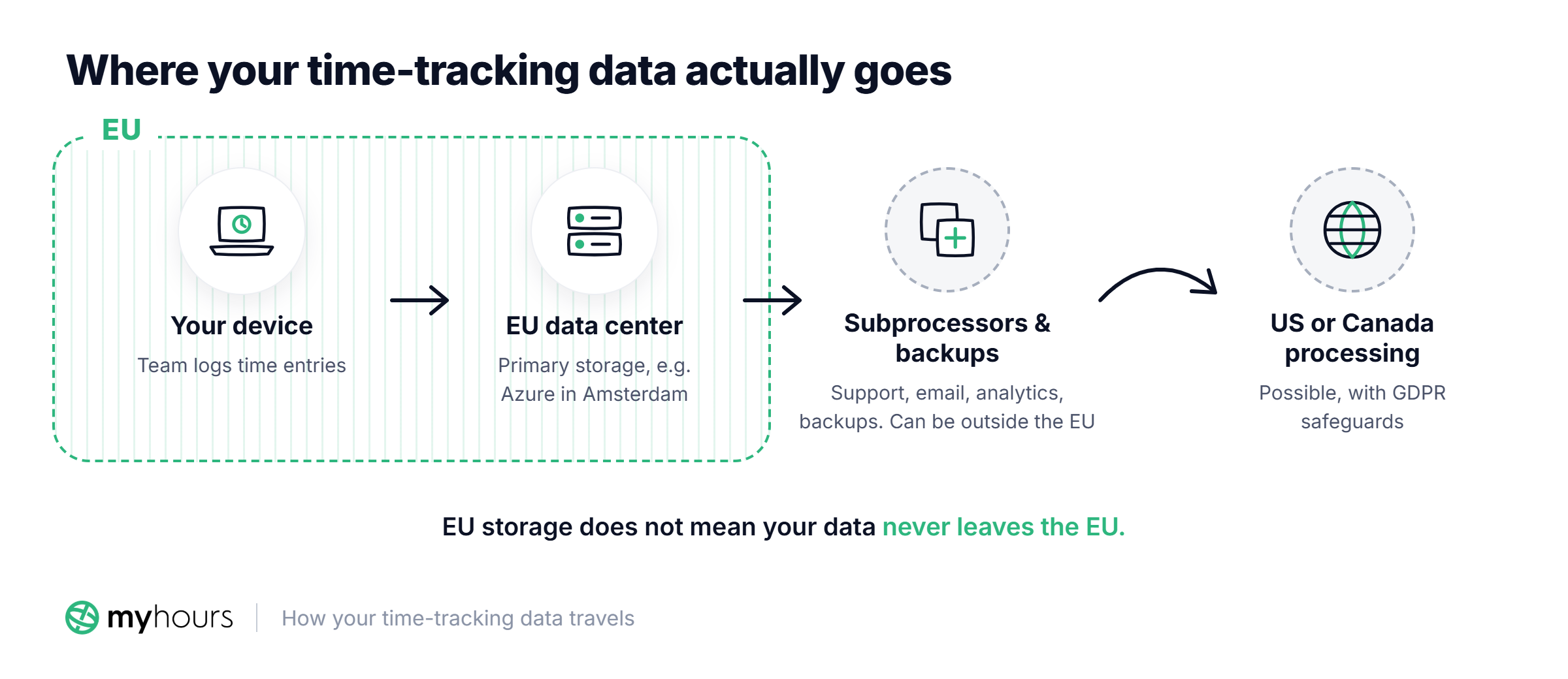
Even if you use a provider that stores data in the EU, that doesn't mean your data never leaves the EU. That vendor almost always relies on other vendors to handle certain things, and those vendors may store and process data in entirely different locations.
Here are key things to know about data pipelines and how they affect your EU data residency concerns.
Storage, Processing, and Third-Party Services
Your provider may store your time-tracking data in an EU data center but use systems in another location to process parts of it.
For example, a separate service might handle customer support, send emails, provide analytics, or process billing information.
It's the same story with the integrations you use.
When you connect your time tracker to another application, some of your data may be sent there too. For example, customers are imported from QuickBooks into My Hours, while invoices are sent back to Quickbooks as time activities, and Jira integrations can send time logs to Jira work logs.
Backups and Data Recovery
Another thing to consider is where the time tracking solution stores your backup data.
Even if your primary database is in an EU region, your provider may keep backups and disaster-recovery copies somewhere else. The location of those copies can matter just as much when you have an EU residency requirement.
If backups are stored outside the EU, strong encryption and careful control of the encryption keys are important safeguards, but only if the keys are controlled exclusively by the exporter or a trusted EEA party. Encryption keys held by the provider are generally not sufficient.
What Happens When Time-Tracking Data Leaves the EU?
The first thing to know is that the GDPR does not require you to keep personal data in the EU or EEA.
So, it's okay if your time-tracking data leaves the region. However, personal data can only be transferred outside the EEA when the conditions set out in Chapter V of the GDPR are met.
One protection mechanism you can use in such a case is what's called an adequacy decision, where the European Commission has determined that a country or sometimes just a specific sector within it offers a level of data protection essentially equivalent to the EU’s.
This isn't just about data protection legislation on paper. The Commission also weighs things like the rule of law, how much access public authorities have to personal data, and whether independent oversight exists. In that case, personal data can flow to that country without requiring an additional transfer safeguard.
When that’s not the case, you can use safeguards like Standard Contractual Clauses (SCCs) or Binding Corporate Rules (BCRs, mainly used by large multinational groups). These provide a legal framework for protecting personal data when it moves outside the EU/EEA.
When you use SCCs, you’re also required to carry out and document a Transfer Impact Assessment (TIA) under Clause 14. It looks at the destination country's laws and whether you need extra safeguards to protect the data.
For US vendors, the EU-US Data Privacy Framework can serve as an adequacy basis, but only for companies that have self-certified under the Framework; otherwise, SCCs (with a mandatory TIA) are typically used.
So, a time-tracking provider processing your personal data outside the EU doesn’t automatically mean it's breaking the GDPR. Confirm where the data goes and what legal protections apply to the transfer.
Having said that, one thing you must consider is your unique EU data residency requirements. A transfer can be lawful under GDPR and still fall outside your organization’s rules.
For example, a client may demand that all their data must be stored and processed within the EU. In that case, GDPR may allow a transfer outside the EEA, but your contract does not.
So before choosing a time-tracking provider, check whether its data storage and processing practices match the residency requirements your business needs to follow.
EU Data Residency Checklist for Time-Tracking Software
When reviewing a time-tracking vendor, use this checklist to find out where your data goes, the controls they provide, and how much they help you meet EU residency requirements.
Storage, Hosting, and Data Processing
- What’s the specific country or cloud region where customer data is physically stored?
- Where is customer data processed, and are the processing and storage locations different?
- Which plans or tiers include EU-based data storage, hosting, and processing?
- Does the vendor's contract specify the region where your data will be stored and processed?
Legal Documentation
- Does the vendor provide a signed Data Processing Agreement (DPA) that outlines how your data is handled?
- Does the DPA specify the data being processed, retention periods, and subprocessor terms?
- Is the DPA available on your plan, or only on a higher tier?
- Does the vendor provide a Transfer Impact Assessment (TIA) or at least document their assessment of third‑country risks and supplementary measures?
Subprocessors and Transfers
- Does the vendor have a list of subprocessors rather than a vague claim like "we work with trusted partners"?
- For any subprocessor outside the EU, do transfer mechanisms like SCCs (Standard Contractual Clauses), an adequacy decision, or DPF certifications apply?
- Are any data types excluded from the EU-residency commitment, like billing data handled by a separate payment provider?
- If data is transferred to the USA, is the recipient covered by the EU-US Data Privacy Framework or another valid transfer mechanism?
Backups and Disaster Recovery
- Where are backup copies stored: same region as primary data or elsewhere?
- Are backup regions documented in the DPA or security documentation?
- Are disaster-recovery copies covered by the same data residency rules as your live data?
- What happens to your data during an outage, a migration, or after you delete your account?
- What happens to your data when you cancel the service?
- When are remaining copies, including the backups, deleted?
Access
- Can vendor staff access customer data internally, and from where (which country)?
- Where are support and engineering teams located, and do they access data from outside the EEA?
- Is access to customer data limited to authorized support and admin staff, and are their access activities logged?
How My Hours Handles EU Data Residency
My Hours is built and operated by Spica International (SPICA), a company headquartered in Ljubljana, Slovenia, with more than 30 years of experience. For businesses concerned about EU data residency, this gives them a clear starting point when assessing whether the platform meets their requirements.
Where your data is stored, how it’s handled, and what safeguards are in place all matter when choosing a time-tracking tool, particularly if your business needs to meet GDPR or internal data protection policies.
My Hours is also a trust-based platform, offering no employee-monitoring features of any kind, such as screenshots or GPS tracking. This means there’s less sensitive employee data to collect and manage.
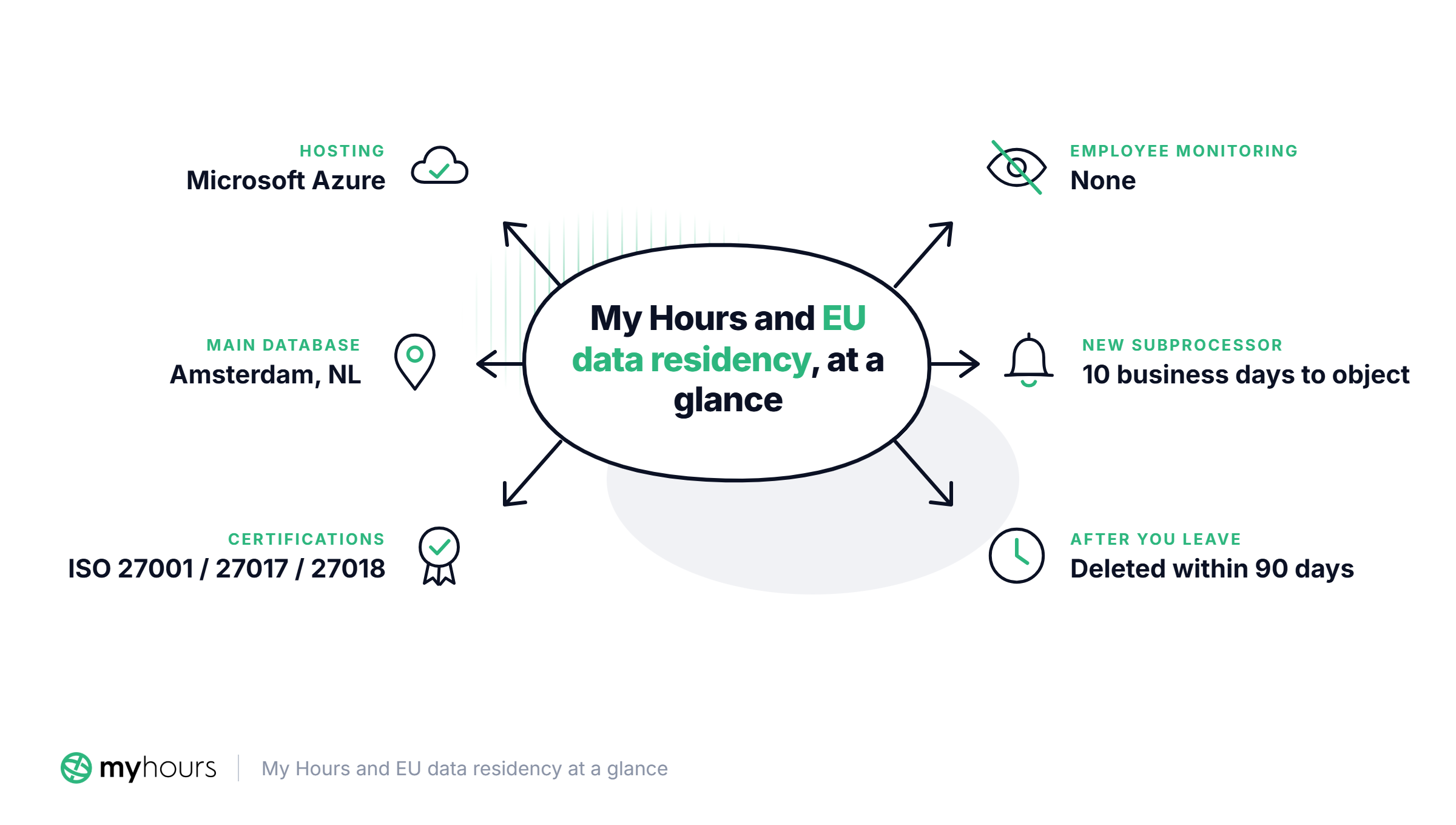
Here’s a closer look at how My Hours approaches EU data residency and the key details to know:
EU-Based Hosting on Microsoft Azure
My Hours hosts its servers on Microsoft Azure, with the main database center located in Amsterdam, Netherlands.
My Hours runs on shared infrastructure, but your data is logically isolated, so it stays separate from other customers' data on the same servers.
As for security, the platform uses TLS 1.3 to encrypt data in transit, helping prevent unauthorized third parties from accessing it as it moves between your device and My Hours.
The infrastructure also undergoes regular security penetration tests and continuous monitoring. Your data is backed up multiple times per hour through Azure.
My Hours holds ISO certifications: 27001:2022, 27018 and 27017. These certifications show that its information security and cloud data protection practices have been assessed against internationally recognized standards.
GDPR Compliance and a Data Processing Agreement
My Hours is GDPR compliant and our DPA defines how SPICA processes and protects your data.
The DPA also gives you a breakdown of the data it covers, including:
- Name and surname
- Contact details
- Client details (not shared with sub-processors)
- Hourly rates (not shared with sub-processors)
- Tracked time (not shared with sub-processors)
Restricted Access and Subprocessor Controls
SPICA and My Hours employees can only access your data for troubleshooting, and that access is restricted, logged, and monitored via secure VPN connections with a full audit trail.
The DPA also lists the subprocessors the platform uses, including Twilio Segment, Intercom, SendGrid, Stripe, Maxio, Zapier, and Hotjar. You can request the complete list from My Hours.
If SPICA ever adds a new subprocessor, you're notified in advance and have 10 business days to object. The exception is urgent security replacements, where you're told as soon as possible afterwards.
Also, for integrations that require data exchange, including QuickBooks and Basecamp, My Hours uses Paragon as its integration provider.
Paragon is SOC 2 Type II certified and states it’s GDPR compliant, with data encrypted at rest and in transit and EU data-residency options for its managed cloud. This gives you another layer of security and data protection when connecting My Hours to other services.
International Processing Specifics
While your main database is in Amsterdam and data is stored on Azure servers in Europe, there are scenarios where that data gets processed in the USA and Canada.
When that happens, there are appropriate safeguards in place to guarantee that your data is still handled in line with data protection law, even outside the EU.
What Happens to Your Data When You Leave
At the end of your agreement, SPICA keeps your data for up to 90 days before deleting it, unless the law requires a longer retention period.
While your subscription is active, you can export your data at any time, so you're never dependent on SPICA to retrieve it for you.
Bottom Line
“Where will my data go and how many third-party services and vendors will interact with it?”
That’s a question the time-tracking partner you intend to work with should be able to answer in clear terms.
You must know its hosting regions, processing locations, subprocessors, and how they handle backups and international transfers.
Use the checklist above before choosing a time-tracking provider, and review the actual terms that apply to your account. Data residency is easier to manage when you know exactly where your data goes from the start.


