
.png)
What Triggers an Audit?
Claiming the tax credit doesn’t necessarily trigger an audit. However, the IRS does audit a portion of all tax returns each year to maintain overall compliance with the rules.
While this is down to the luck of the draw, the following instances are most likely to trigger an audit:
- If the claim is substantial
- If the claim had poor or inconsistent documentation
- If high-risk data patterns are identified (like sudden claim spikes or claims that look anomalous in relation to company size or norms)
Additionally, updated reporting requirements have given the IRS more data to risk-assess returns, which has led to more intensive claims examinations.
Documentation quality has, therefore, become a key reason why an audit is triggered and plays a central role in whether a claim is approved or denied.
The two key focus areas during an audit are:
- Substantiating qualified research activities: Whether each claimed project sought to resolve a technological uncertainty via a process of experimentation.
- Tying expenses to activities: Whether there’s a clear link between every claimed dollar and the qualified research.
How to Assemble an R&D Audit Packet
The IRS doesn’t have a single checklist, yet examiners expect a broad packet of records that includes:
- Project
- Technical
- Financial
- Governance
Each record must allow examiners to trace every dollar back to the qualified research activities.
The checklist below is what is typically requested during an R&D tax credit audit under IRC §41 and Treasury Regs §1.41‑4(d) and §1.6001‑1.
1. Core tax and accounting files
First, start by gathering:
- ☐ Filed federal returns for each year under audit, including all credit schedules
- ☐ Form 6765 and papers showing how each line was calculated (see below)
- ☐ Prior year returns (including Form 6765)
- ☐ Any state-specific R&D credit forms (if relevant to audit scope)
Regarding the credit calculations related to Form 6765, you must:
- ☐ Show the step-by-step process, including the calculation method used (Regular or ASC)
You must also include:
- ☐ Base amount/fixed-base percentage support (if the Regular Credit method was used)
- ☐ Gross receipts schedules used for the base period and claim year(s)
- ☐ Reconciliations that tie numbers back to the trial balance, payroll registers, financial statements, and tax return totals.
Furthermore, you need to compile an accounting reconciliation pack that demonstrates exactly where the credit claim amount arrived from:
- ☐ Qualified research expense (QRE) summary by year matching Form 6765 totals.
- ☐ The general ledger for all accounts that feed QREs, including wages, supplies, and contractors, with corresponding project codes or cost centers.
- ☐ Trial balances and reconciliations from the general ledger totals to the QRE totals claimed.
- ☐ Cost-allocation methods across projects, locations, and business units.
- ☐ A nexus between accounting records and project-level activity, like project-coded entries or crosswalk tables from the general ledger to project lists.
2. Project and business components
The IRS places a heavy focus on business components and nexus. Therefore, for each component, you must assemble the following:
Master list and nexus map
This is a compilation of all projects claimed as qualified research, clearly mapped to business components as mandated by Form 6765.
For each component, you must include the following information:
- ☐ Component name and short description
- ☐ Dates/phases
- ☐ Team members and their roles
- ☐ Where costs live (cost centers, codes, etc.)
You also need a nexus map, which will link everything together (component > activities > cost) to show:
- Which employees worked on which components
- Which supply purchases relate to which components
- Which contractors/SoWs relate to which components
You can do this by using software that links everything together on your behalf, like time tracking software.
Creating a nexus manually is another option, with links in spreadsheets; however, that will create a lot of work for you.
R&D roadmaps
You are also required to show overall R&D objectives and goals that were mapped out over the course of the year, such as:
- ☐ Project charters and business cases
- ☐ R&D and product roadmaps
- ☐ Annual R&D plans that highlight business objectives and technical goals
- ☐ Project timelines and milestones
Four-part test qualification
Each business component has to meet the requirements set out by the four-part test.
This means you must include documentation that demonstrates:
- ☐ The activities carried out were intended to create new or improved:
- Function
- Performance
- Reliability
- Quality
- ☐ The work relied on hard sciences, like:
- Engineering
- Computer science
- Biology
- Chemistry
- Physics
- Mathematics
- ☐ The activity involved the elimination of uncertainty, such as:
- Capability: Can it be done?
- Method: How to do it?
- Design: Which approach will work?
- ☐ There was a process of experimentation, including:
- Modeling or simulation
- Prototyping
- Iterative testing
- Evaluating alternatives
- Trial and error (grounded in science or engineering
Contemporaneous technical evidence
Next, you must provide all evidence of work carried out.
It’s best practice to create this documentation at the time the work happens, rather than after the fact.
Use a clear file naming convention that describes what each file contains and how it relates to other files. Include the following:
- The date (YYYYMMDD)
- The business component or project ID
- Activity or evidence type clearly labeled
- Person/system/instrument identified
- Version control (v1, v2, v3, etc.)
A couple of examples to see what this looks like in practice:
- 20260215_ProjPhoenix_DesignSpec_DataPipeline_SmithJ_v1.docx
- 20260208_ProjNova_LoadTest_APIThroughput_Fail_WilsonT_v1.xlsx
Here are the types of documentation that are required:
- ☐ Design documents, specs, diagrams
- ☐ Engineering and lab notebooks
- ☐ Test plans, cases, and results
- ☐ QA reports
- ☐ Prototypes, build and release notes, changelogs
- ☐ Version control history
- ☐ Jira, Azure, and DevOps tickets
- ☐ Sprint boards
- ☐ Experiment logs, benchmarking results, and simulation outputs
- ☐ Failure analysis, including defect reports and root-cause analyses
- ☐ Meeting notes that demonstrate decision-making and technical uncertainty
- ☐ Patent filings
- ☐ Milestone reports, sprint reviews, and status reports
3. QRE financial substantiation (personnel, time, and wages)
This is where you have to show who did what and how you quantified it, particularly for wages, since they make up a large portion of R&D costs.
Personnel
A complete organization chart is required for each department related to R&D, including:
- ☐ Name of each department
- ☐ Employee names and roles for each department
- ☐ Reporting lines per department
It’s also necessary to demonstrate how employees’ duties are aligned with qualified services. For every individual involved in R&D, you must provide:
- ☐ Job description
- ☐ Department description
Time tracking reports
The IRS prefers contemporaneous time tracking (where time is tracked in real time, not after the fact) because it provides defensible records.
Each individual working on R&D activities must track their time and link hours to specific R&D projects.
Therefore, timesheets must include:
- ☐ Employee name
- ☐ Dates
- ☐ Hours spent per task
- ☐ Project name and code
- ☐ A description of the activity carried out
- ☐ The cost of labor and other expenses
Wages
Wage documentation is extremely important, since the cost of paying employees for their time on R&D activities is high.
Gather the following:
- ☐ A detailed list of all employees included in wage QREs, including titles, departments, locations, and the percentage of time claimed for qualified activities.
- ☐ Payroll registers, W-2s, W-3s, and payroll system reports that reconcile wage QRE totals to total compensation
- ☐ Details of excluded wages (HR, finance, etc) to demonstrate that non-qualified activities were properly omitted.
- ☐ Breakout of officers’ wages included in QREs
Supplies and property
Another large portion of costs comes from supply and equipment purchases for R&D initiatives.
You need the following documents for all R&D related supplies:
- ☐ Detailed list of all supply accounts, including materials, quantities, and costs
- ☐ Invoices, purchase orders, vendor statements, and receiving documents
- ☐ Inventory and consumption records
- ☐ Scrap reports and write-off documents
- ☐ Documents to show how supplies were used or consumed in qualified activities
- ☐ Cost accounting records that tie supply accounts and cost centers to specific R&D projects where materials are pooled.
Third-party agreements
If you work with third-party vendors and organizations to further your R&D research, then you must also include the following:
- ☐ A contract summary table of vendors, dates, supported business components, and amounts claimed
- ☐ Master service agreements and statements of work
- ☐ Invoices and payment records (mapped to specific projects)
- ☐ For blended contracts, documentation that distinguishes R&D work from non-qualified activities
- ☐ Evidence of control and direction over third-party researchers
5. Base period /carry-forward support
Depending on the method and years examined, you may be required to include:
- ☐ Prior-year credit calculations used to determine the base amount or fixed percentage
- ☐ Gross receipts schedules for base years used
- ☐ Details of any mergers, acquisitions, reorganizations, or ownership changes
- ☐ Credit carry-forward schedules and their application
If you are unsure about this section and whether you need to include it, consult the IRS or an advisor.
6. Corporate governance and internal processes
The IRS also requires evidence on how you structure your policies and internal processes. Even training materials need to be examined:
- ☐ Any minutes from R&D committees and board meetings
- ☐ Internal authorizations for major projects and budgets
- ☐ Internal R&D policies and standard operating procedures
- ☐ Engineering or scientific methodology documents that describe how projects are executed and evaluated
- ☐ Internal audit, tax, and controller notes that assess R&D credit risk, controls, and methodology
- ☐ Staff training materials regarding time tracking and project coding
7. Audit-specific items
Aside from the documentation we already discussed, which you should already have on hand, you may be asked to hand over additional items just for the audit, such as:
- ☐ Responses and any referenced attachments to the IRS’s mandatory research credit claim IDR questionnaire
- ☐ Any prior IRS or state audit reports, including closing agreements and correspondence regarding R&D credit for earlier years
- ☐ A written description of the methodology used to prepare for the R&D tax credit claim
- ☐ Copies of any engagement letters, notes, or deliverables with third-party advisors
- ☐ Any fee structures arranged with third-party advisors
- ☐ Any computation check sheets or internal lists that were used when finalizing the credit application
Overlooked Helpful Evidence (That You Should Also Include)
These items are often left out of an audit packet, but they can be really helpful because they act as supporting evidence.
Before you complete your file, run a check to see if you can include any of these things:
- ☐ Emails or conversation thread summaries from collaboration tools like Jira, Asana, and Slack that demonstrate experiment planning, technical problem-solving, and design debates
- ☐ Market or sales assets that corroborate a new or improved product (this is simply to act as supporting evidence, not as primary proof)
- ☐ Regulatory or customer documents that created a technical challenge leading to complex engineering work
- ☐ Beta-test feedback, pilot reports, and demonstrations that show iterative development and any failed attempts before success
How to Stay Prepared for an R&D Audit
The best way to avoid trouble during an audit is to prepare documentation as you carry out R&D activities, not after the fact.
Before you embark on a new R&D project, consider the following:
- What documentation must be maintained
- Where gaps lie and how to remediate them
- What evidence should be retained
- How to structure all documentation
- How to ensure nexus between documentation, systems, and activity
Then, make sure that you have:
- Clearly defined how the activity meets the four-part test criteria
- Identified each business component and which activities and expenses relate to it
- Established contemporaneous evidence practices (like saving files, tickets, meeting notes, etc.)
- Implemented a clear file naming convention
- Aligned technical documentation with financial systems
- Established a strong time tracking method
- Created a living audit index or document register that maps evidence to business components and QRE categories
- Trained relevant staff in documentation methods and obligations
How Time Tracking Software Helps Create R&D Nexus and Audit Readiness
One of the biggest challenges is keeping every piece of evidence connected to a business component and the associated cost, time, employee(s), etc.
The right software helps establish those links from the start and keeps you audit-ready throughout the year.
Time tracking software is especially valuable because:
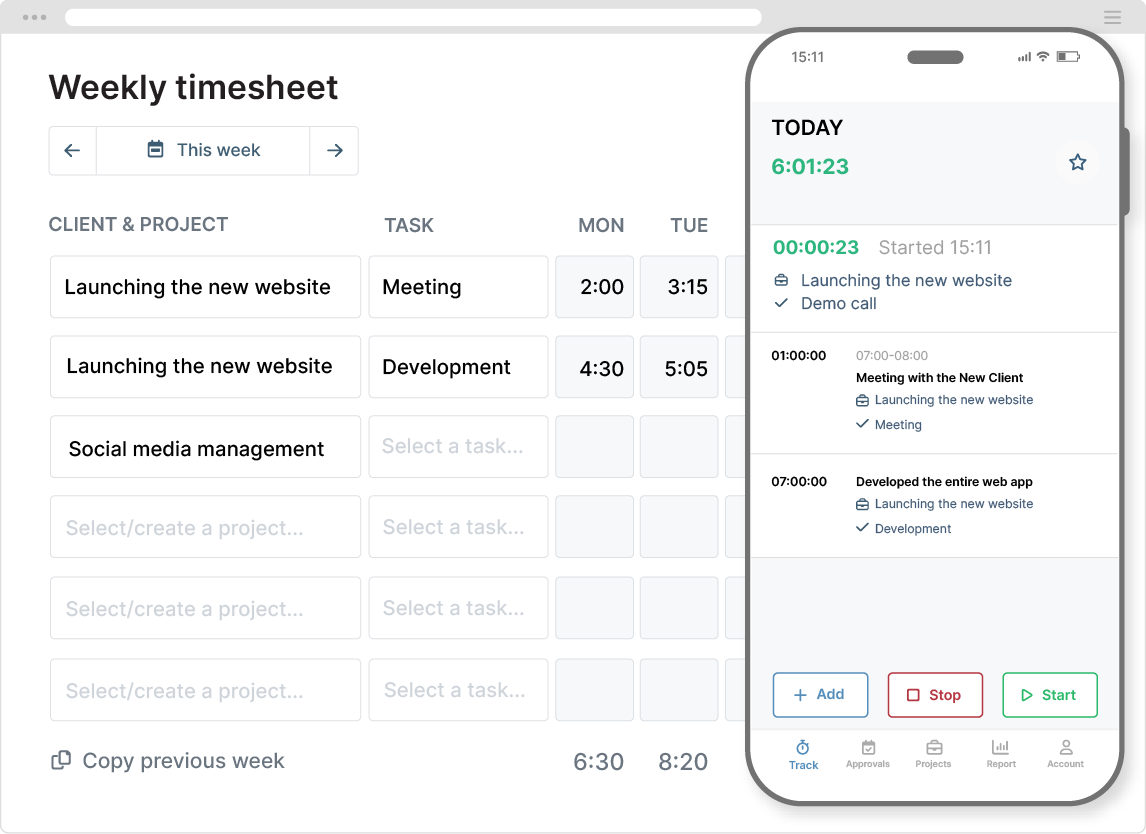
- Time is tracked in real time and linked to specific projects (business components) and tasks (R&D activities).
- Time entries are compliant with IRS requirements since they contain all the necessary information, including a field to input a description of the work carried out.
- Each time entry is linked to the individual who worked on a task, plus the system allows you to create organizational hierarchies (teams, managers, etc).
- Labor costs can be assigned to all users and tracked as they track their time. This ensures accurate costs are linked to R&D activities.
- Custom fields allow you to input job codes and cost centers related to relevant business departments.
- Custom tags enable you to correctly label time entries (qualified, non-qualified, etc.) and filter them for reporting purposes.
- You can upload supply and equipment expenses to time entries as needed, with their costs accurately recorded (complete with uploads of receipts and invoices).
- Timesheet validation workflows ensure that time entries are present and correct before they are submitted to payroll and assigned to R&D expenditure.
- Granular reporting options generate the right data for IRS audit purposes.
- A clear audit trail shows every change and adjustment made within the system.
- Links to file systems and document depositories can be included on time entries to provide a nexus to technical evidence.
- Time tracking software integrates with project management, CRM, accounting, and invoicing tools to provide additional nexus to financial and project information.
What to Expect During an R&D Audit?
Audits are not fast processes and take many months to complete. The good news is that if your documents are in good order, the timeline will be much faster. Expect:
- 6-9 months for a well-documented claim
- 9-18 months if your documents are average or include estimates instead of exact numbers
- 18-36+ months if your claim is considered high-risk or has very poor documentation
If your organization is selected for an audit, the general process is as follows:
- An official initial examination notice and information request are sent to your organization. You will need to supply all R&D financial documentation, project lists, and records.
- An opening conference is organized where an IRS agent will ask questions to understand your business, R&D process, and how you prepared for the credit claim.
- The agent will issue additional requests for project documentation, such as design documents, prototypes, test analysis, etc.
- The agent reviews whether or not each project meets the four-part test requirements and if there is a clear nexus between claimed wages, supplies, and qualified research activities.
- It’s also possible that an external engineer or scientist may examine technical uncertainty resolution.
- Financial processes may also be verified, including payroll and vendors.
- Expect the IRS agent to hold interviews with technical leads and R&D employees to gain insight into projects and processes.
Once all the reviews have been completed, the IRS agent will issue one of three outcomes:
- Accept the credit as filed
- Partially allow the credit with proposed adjustments
- Fully disallow it
Depending on the outcome, you can:
- Agree and sign it
- Provide support to try to resolve any highlighted issues
- Dispute the outcome and begin the formal appeals process
Final Thoughts
Assembling an audit packet shouldn’t be a stressful experience if you have already taken care to set up the right systems and documentation processes.
Plus, having everything in place will make claiming the tax credit easier and keep your R&D efforts organized.


