

What Is Time-and-Materials Billing?
Time-and-materials (T&M) billing is a pricing model that charges clients for the hours worked and the materials or expenses used on a project. Labor is usually billed at a pre-agreed hourly rate, but the final project cost isn't fixed until the work is done.
T&M protects the service provider from absorbing the cost of work that exceeds the initial estimate.
What is the difference between T&M and fixed pricing?
Unlike T&M billing, fixed-fee billing involves the client agreeing to a set price before work begins. Whether the project takes fewer or more hours than expected, the price remains the same. Fixed-fee pricing protects the client from incurring unexpected cost increases.

Neither model is fundamentally better than the other. T&M billing works best for projects where the scope isn’t fully defined upfront or is likely to change. Think consulting, retainers, maintenance, support contracts, construction, software development, and freelance work.
Fixed-fee pricing suits projects with a clearly defined scope and deliverables that both parties agree on before work begins. Examples include a construction build with an approved blueprint or a website redesign with a signed-off list of pages and features.
Each model carries its own risk:
- Fixed-fee pricing risks underestimating the work involved
- T&M risks failing to record every billable hour and expense
Underbilling is the harder risk to catch, because an incomplete invoice doesn't raise red flags. It just looks like a normal invoice, but it’s the one that makes you lose revenue.
Why T&M Billing Is More Exposed to Profit Leaks Than Fixed-Fee Work
On fixed-fee projects, profitability is measured against a predefined price. If a project takes longer than expected, the loss is immediately visible because the actual costs exceed the budget that all parties agreed to.
By contrast, T&M billing doesn’t have the same built-in checkpoint. Every invoice is different because it's based on the actual time and materials recorded.
For example, suppose the project is billed at $150 per hour with a target of 100 hours. If the team actually works 160 hours but only bills 100 because 60 hours spent on client calls, revisions, and last-minute changes were not recorded, the business loses $9,000 in billable revenue.
Unlike a fixed-fee project, there’s no predetermined contract value to compare against, so an under-billed invoice often looks perfectly normal. It only becomes obvious if someone compares billed hours against the work that was actually completed, which is often a manual and time-consuming process.
That’s what makes T&M profit leakage so hard to detect. It comes from a series of small, easily overlooked mistakes, like a 10-minute client call that wasn’t added to the timesheet, or an outdated billing rate that wasn’t updated post-negotiation.
The leakage won’t show up on any profit and loss statement as a “billing error,” but it will drain your margins.
The 5 Places Profit Leaks Out of a T&M Project and How To Fix Them
Most profit leaks in a T&M project can be traced to five recurring patterns. They tend to occur together, making their cumulative effect greater than any single mistake.
Unlogged or delayed time
Short client calls, quick email replies, and tiny revisions are among the easiest tasks to forget. When time entries are filled days later instead of right after the work happens, these tasks may be forgotten entirely.
Across a 10-person team, a few unlogged minutes daily add up to dozens of invoiceable hours lost every month.
What you can do about it: Set a daily structure for logging time and track short activities as you do long ones. A 5-minute end-of-day habit of recording hours worked will serve you better than trying to reconstruct the whole week from memory.
Threshold aversion
Sometimes you remember a six-minute task and don’t log it because it feels too insignificant to bill. A brief email thread can seem the same way, so it gets left off the timesheet.
Without clear rules about what counts as billable work, these omissions can become a habit that slowly affects revenue.
What you can do about it: Log everything first, then decide what's billable afterward. Also, make non-billable an explicit choice on every entry, not a default.
Rate drift
Billing rates are typically set at the start of a project or when someone joins the team.
However, costs don’t stay static. Salaries, overhead, software renewals, and other operating costs tend to increase even if slightly. And this can impact profitability.
A billing rate should cover your total cost per billable hour, including those expenses, while leaving room for profit. To find that number, start with the fully loaded cost of employing someone (salary, benefits, overhead, software, and a tax buffer), then divide the total by your annual billable hours target.
Add a profit margin on top that reflects the value of your expertise. That's what you should be charging.
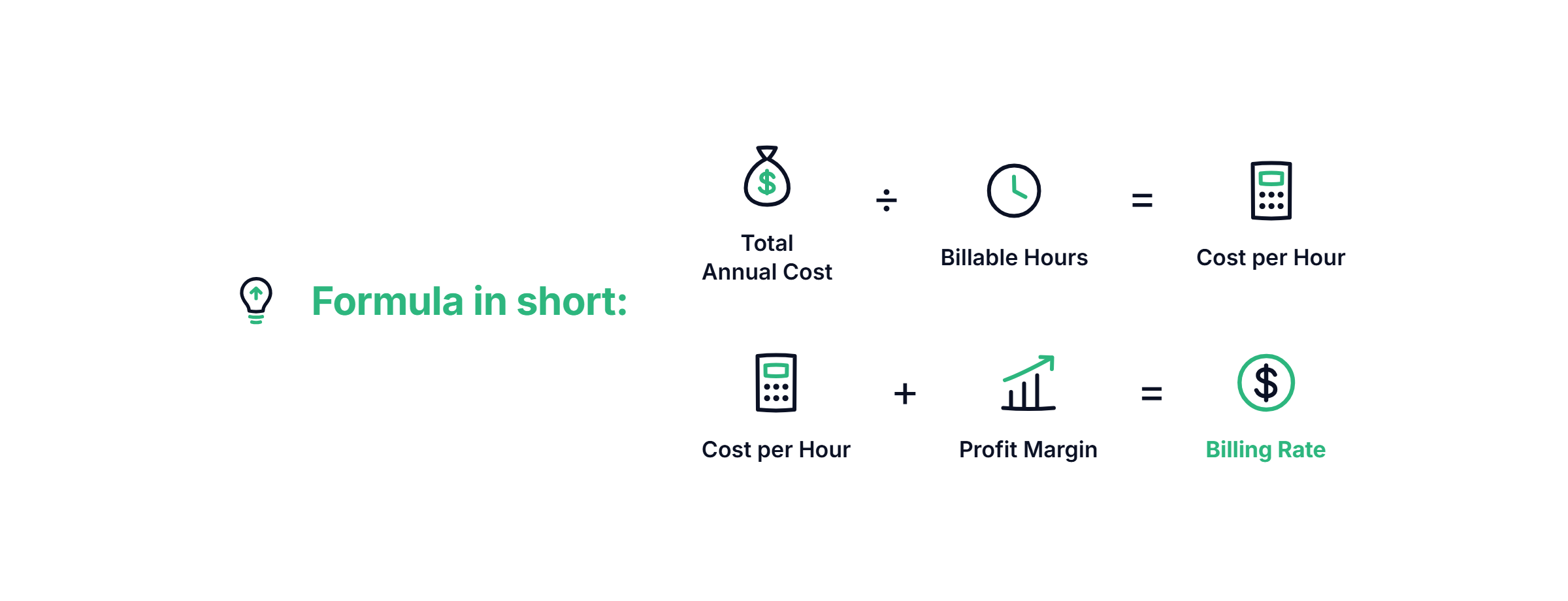
If your rates aren't reviewed as those costs change, your margins gradually shrink because you're charging clients the same amount.
What you can do about it: Review and adjust your rates as needed, at least annually. Put the review on a recurring calendar reminder rather than waiting for a client renewal or a noticeable margin drop to prompt it. Also, separate the labor cost and billing rates, so you can track each one changing on its own.
Rework, scope creep, and inefficient processes
Poor acceptance criteria, unclear requirements, and defects caught late mean you'll have to repeat work. The client doesn't pay for a redo because the fault is on your end. You absorb the hours it takes to fix, on top of the time spent on the original work.
Scope creep works the same way from the opposite direction. That client request for "one small thing" feels too minor to renegotiate the contract over, so it never gets flagged. Repeat that across a six-month engagement, and you've delivered a meaningful volume of work no one is paying for.
The cost of the rework itself is obvious. The “hidden aspect” is that the assumptions and inefficient processes behind it only become obvious once the rework has already happened.
What you can do about it: Nail down acceptance criteria before work starts, so “done” has a clear, agreed-upon definition instead of being open to interpretation. Catching a requirement gap in a kickoff call is far cheaper than catching it after three rounds of unbillable fixes. Log scope additions the moment they happen, so there's a visible audit trail.
Expenses tracked separately from time, or not tracked at all
Reimbursable costs, like travel, software, subscriptions, or subcontractor invoices, often live in a separate system from time logs, or in no system at all. This is particularly true if you’re using the wrong time tracking app.
By the time someone remembers to invoice clients for billable expenses, the receipts may be missing, or the client relationship may have ended. That means your firm would have to absorb the avoidable cost.
What you can do about it: Log expenses as you spend and attach the expense to the appropriate project and task. Also, mark expenses as billable or non-billable.
4 Ways To Spot and Measure T&M Leaks
Many T&M billing leaks are only visible when you decide to actively look for them.
Here are four checks that can help you spot these profit drains:
1. Reconcile time-to-invoice every month
Compare approved timesheet hours against what actually got invoiced, and look at the gap by project and by worker, not just as one company-wide number. Even if you miss a divergence at the aggregate level, it's easy to spot when you break it down that way.
2. Track out-of-scope hours against the original baseline
Every change request should get logged the moment it happens, with a timestamp attached. Over time, this lets you see what percentage of total hours on a project came from work that was never part of the original scope.
3. Monitor the effective hourly rate by role
Divide billed revenue by actual hours worked for each role on the team. If a senior consultant's rate is lower than it should be, you’re likely paying them to spend time on lower-value tasks that a junior team member could handle.
4. Review how long it takes to invoice logged work after it's completed
Pull a report of logged time and expenses that haven't been invoiced yet, sorted by how long each one has gone unbilled. The longer an entry goes without being billed, the more likely it is to get written off or forgotten.
Because My Hours ties time, expenses, and invoicing together in one place, checking how long work has sat unbilled is a report away. You won't have to sift through old files or email threads.
How Much Profit Leakage Actually Costs
The financial impact of T&M profit leakage is bigger than most firms realize, and the realization rate is where it becomes obvious.
The average realization rate shifts across different industries. For example, in 2025, it was 88% for legal firms. This means that for every $1,000 worth of billable work a lawyer performs, only $880 actually makes it onto an invoice.
For a firm generating $2 million in billable work each year, that 12% gap amounts to roughly $240,000 in completed work that never gets billed.
Unlike utilization, which measures how much time is spent on billable work, the realization rate measures how much of the billable work is invoiced and collected.
A team can have excellent utilization and still lose revenue if billable hours never make it to an invoice.
Good vs. Bad Time Entries in T&M Billing
Another factor that affects how much of your work turns into revenue is the quality of your time entries. If a client or internal reviewer can't tell what a logged hour covers, they’re more likely to question it, request a discount, or reject it entirely.
Here are some good and bad patterns.
What Happens When You Update a Billing Rate Mid-Project
Updating billing rates shouldn’t create accounting problems. However, in some T&M billing systems, it does, because of how those tools store billing rates and apply them to time entries.
Some solutions treat the billing rate as a setting attached to a project or user. When that rate is updated, the change applies to every associated entry, including work logged months earlier.
As a result, older reports no longer match the invoices that have been sent out, turning reconciliation into a time-consuming, entry-by-entry review.
A more effective approach is rate versioning, where each time entry keeps the billing rate that was in effect when the work was logged. When a billing rate changes, the new rate applies only to future time entries, while the previous invoices retain their original rates.
This preserves the accuracy of historical invoices and reports, eliminating the need for corrections. It’s like how payroll works. A raise this month doesn’t rewrite last month's paycheck; it only affects future payments.
Billing rates should work in the same way, and this is something to check for before you commit to a time tracking tool, since not every system protects historical entries by default.
A Quick Self-Audit: Is Your T&M Billing Leaking?
Run through this checklist below to assess your operations for potential revenue leakage. If you check more than two or three boxes, your T&M billing process may have more losses than you realize.
- Is time logged at the end of the week instead of daily or in real time?
- Does your team lack a documented rule or policy defining what counts as billable vs non-billable work?
- Have your billing rates gone unreviewed for more than 12 months?
- Have you completed out-of-scope work without adjusting the budget, billing rate, or client agreement in the past quarter?
- Are reimbursable expenses tracked outside your time-tracking system (a separate spreadsheet or email thread) or not tracked until it’s time to invoice?
- Would your team struggle to report your firm’s current realization rate?
- Has a rate change required manual corrections to old invoices or reports?
How My Hours Helps You Bill T&M Work Accurately
Your T&M billing may suffer leaks when not properly implemented. However, it's a solid pricing model and is being adopted more.
T&M pricing now makes up 43.5% of contracts and is rising because it gives both sides more flexibility than locking in a fixed price upfront.
Preventing profit leakage requires a billing system designed to support accurate time tracking, flexible pricing, and consistent invoicing.
My Hours is built for the parts of T&M billing that tend to leak. We bring these capabilities together so you can stay profitable without extra administrative work.
- Flexible billable rates: My Hours lets you set unique rates by user, project, or task, with flexibility to override default rates for specific clients or work. Every timelog calculates and reflects the correct rate automatically without any manual adjustments at invoicing.
- Rate history that doesn't rewrite past invoices: My Hours maintains a complete history of billing rates, keeping past logs at the rate that was in effect when the work was tracked. New rate changes apply only to future entries, so historical invoices and reports remain accurate and fully aligned with what clients were originally billed.
- Budget monitoring and alerts: Set project budgets based on time or monetary value and receive automatic alerts as they are consumed. My Hours highlights projects that are approaching their limits, helping teams address scope changes or renegotiate their budgets before profitability begins to decline.
- Automatic time rounding: For organizations that bill in standard increments, My Hours automatically rounds billable time up, down, or to the nearest interval, from one minute to a full hour.
- Integrated expense tracking: Expenses get logged alongside time entries, assigned to the right project, with receipts attached, so reimbursable costs are less likely to get missed.
- Faster, more accurate invoicing: My Hours automatically pulls approved time entries and billable expenses into itemized invoices. This means you don’t have to manually reconstruct billing periods from spreadsheets or handwritten notes.
Whether you’re managing T&M projects with different billing structures or balancing them alongside fixed-fee engagements, My Hours allows you to support both from a single platform.
Bottom Line
T&M billing isn't the problem. Untracked time, stale rates, and unflagged scope are.
None of these leaks show up as a single obvious mistake, which is exactly why they're easy to miss until a margin comes in lower than you expect, and nobody can point to why.
The fix involves logging time the same day, reviewing rates on a schedule, and flagging off-scope tasks the moment they occur. Accurate T&M billing starts with accurate tracking.
To see where your T&M work is leaking, sign up for a 14-day free trial of My Hours.


